
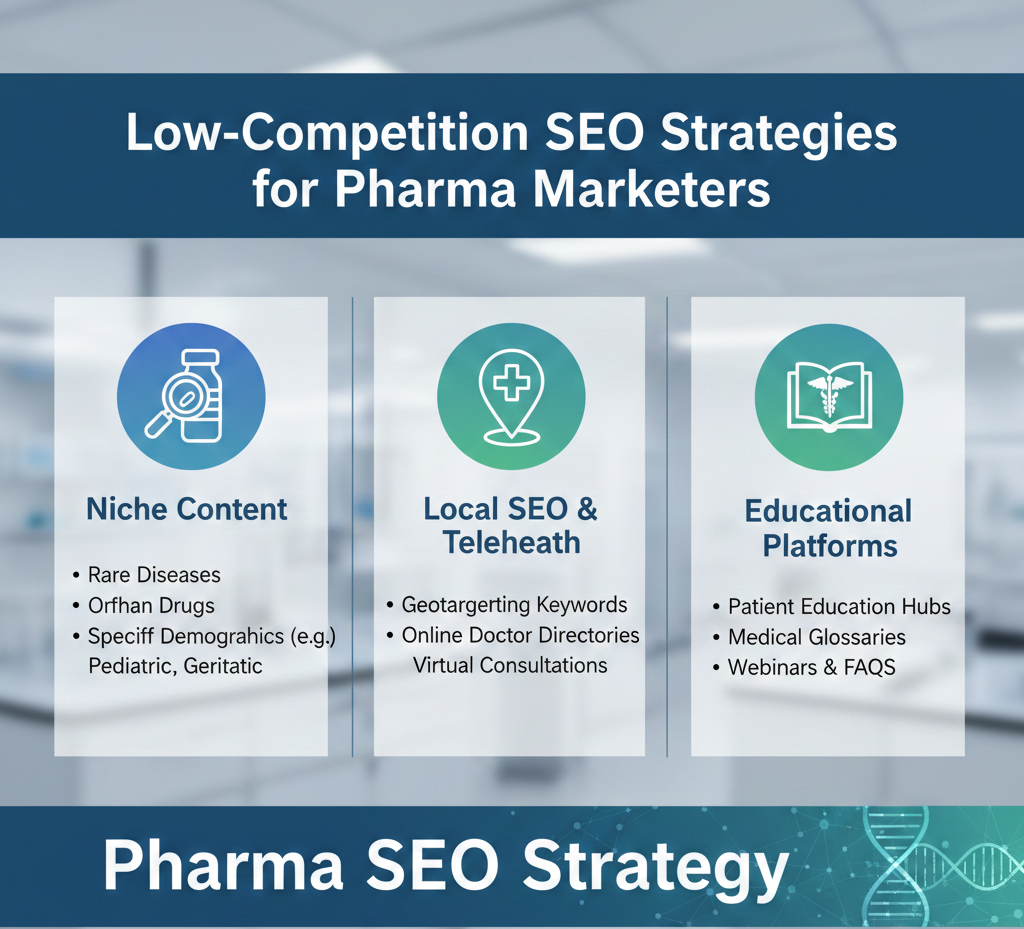
Understanding the U.S. Pharma Digital Landscape
The U.S. pharmaceutical market is undergoing a digital transformation at an unprecedented pace. Digital marketing spend by pharma companies exceeded $8 billion in 2024, doubling from 2018 levels (Statista → https://www.statista.com/statistics/801816/pharmaceutical-industry-digital-ad-spending/). Despite this surge, many mid-size and specialty pharma organizations struggle to achieve meaningful digital visibility because high-volume, generic keywords are dominated by authority domains, such as WebMD, Mayo Clinic, and NIH.
Low-competition SEO is the strategic solution for capturing qualified traffic without competing directly against large medical portals. By targeting niche, high-intent keywords, marketers can reach healthcare professionals (HCPs) and patients effectively, while maintaining regulatory compliance.
Key Benefits of Low-Competition SEO:
- Targeting high-intent audiences efficiently
- Ranking for long-tail, low-competition keywords
- Building trust through evidence-based content
- Reducing dependency on costly paid campaigns
This guide provides a comprehensive roadmap for pharma marketers, covering keyword research, content strategy, HCP vs patient segmentation, compliance, link-building, performance monitoring, and long-term growth.
The Importance of Low-Competition SEO in Pharma
- Challenges of High-Volume Keywords
Attempting to rank for broad keywords such as “diabetes treatment” or “migraine therapy” can be costly and ineffective:
- Paid campaigns targeting generic terms often have CTR below 1%
- Organic ranking is dominated by authority medical websites
- Limited visibility for mid-size pharma companies
Example:
A campaign targeting “migraine therapy” cost $35,000 over three months with minimal qualified traffic.
Shifting focus to a long-tail keyword like “episodic migraine triggers in women over 40” resulted in triple the CTR and higher engagement from the target audience.
- Compliance Enhances SEO Authority
Following FDA OPDP guidelines (https://www.fda.gov/about-fda/center-drug-evaluation-and-research-cder/office-prescription-drug-promotion-opdp) ensures content is:
Evidence-based
- Neutral and non-promotional
- Trustworthy for both HCPs and patients
- Compliance builds digital authority, improving search ranking due to Google’s E-A-T (Expertise, Authority, Trustworthiness) algorithm.
- Semantic Search and AI-Driven Ranking
Search engines now prioritize user intent and contextual relevance over raw keywords. Pharma marketers can optimize by:
- Structuring content around diagnosis → treatment → monitoring
- Incorporating clinical guidelines and studies
- Targeting niche, long-tail queries for specific audiences
Example:
Broad: “Migraine causes in adults”
Long-tail: “Migraine triggers in women aged 35–50 during menstruation”
The long-tail approach drives higher qualified traffic, better engagement, and improved conversions.
Identifying Low-Competition Keywords
Effective keyword research requires a structured approach:
Step 1: Long-Tail Symptom Queries
Example keywords:
- “Episodic migraine triggers during menstruation”
- “Morning stiffness RA vs OA”
- “Psoriasis plaques behind ears treatment”
Benefits:
Less competition
Higher CTR
More qualified traffic
Step 2: Disease Subtype Keywords
Example keywords:
- “HER2-low breast cancer treatment”
- “Mild intermittent asthma in teenagers”
Impact: Builds authority among niche HCP and patient audiences.
Step 3: Care Pathway Keywords
Example keywords:
- “Best imaging sequence for multiple sclerosis”
- “ANA panel interpretation for autoimmune screening”
- Content structured around the screening → diagnosis → treatment → follow-up pathway increases relevance and engagement.
Step 4: Clinical Evidence Keywords
Example keywords:
- “Phase 3 endpoints in ulcerative colitis trials”
- “Progression-free survival meaning in oncology”
- HCPs frequently search for trial-specific data, often underserved by generic content.
Step 5: Rare Disease Keywords
Example keywords:
“Pompe disease adult treatment pathway”
“Fabry disease cardiac involvement early signs”
Sources:
- NIH GARD → https://rarediseases.info.nih.gov
- NORD → https://rarediseases.org
Rare disease content drives long-term authority and engagement.
Step-by-Step Pharma SEO Strategy
Step 1 – Pillar & Cluster Content
- Pillar Page: Comprehensive disease overview (4,000–6,000 words)
- Cluster Pages: Symptom management, treatments, care pathways, FAQs (800–1,500 words each)
- Example: Rheumatoid Arthritis (RA)
- Pillar: RA overview, epidemiology, pathophysiology
Clusters:
- Early RA Diagnosis Checklist
- Symptom Subtypes
- Biologics vs JAK Inhibitors
- Lab Monitoring Guidelines
Pillar pages centralize authority and improve internal linking and SEO performance.
Step 2 – Keyword Mapping
- Tools: SEMrush, Ahrefs, Ubersuggest
- Segment by audience: HCP vs patient
- Assign low-competition keywords to cluster pages
Step 3 – Content Creation
- Use active voice, 2–4 line paragraphs
- Structure: diagnosis → treatment → monitoring
- Include evidence-based guidance and references
Example:
Instead of: “Drug X may help RA patients”
Write: “Clinical trials demonstrate biologic A reduces morning stiffness in RA patients unresponsive to DMARD therapy (PubMed → https://pubmed.ncbi.nlm.nih.gov).”
Step 4 – On-Page SEO
- H2/H3 headings with keywords
- Meta descriptions and alt text
- Internal linking from pillar → cluster pages
- Schema markup: MedicalWebPage, MedicalCondition, Drug, HowTo
Step 5 – Compliance Review
- Avoid promotional claims
- Include risks, side effects, guideline references
- Maintain neutral, evidence-based tone
Step 6 – Performance Monitoring
- Track impressions, clicks, CTR, rankings (Google Search Console)
- Update quarterly or when guidelines/trials change
Content Planning for Patients vs HCPs
Patient-Focused Content
- Early warning signs: “Lupus flare indicators”
- Therapy expectations: “First biologic injection guide”
- Long-term management: “Migraine preventive therapy timeline”
- Rare disease awareness: “Fabry disease cardiac symptoms explained”
HCP-Focused Content
- Diagnostic criteria: “2024 ACR RA criteria explained”
- Treatment sequencing: “Biologic therapy initiation workflow”
- Biomarker interpretation: “ANA patterns and clinical significance”
- Monitoring schedules: “Lab frequency for biologics in RA”
- Clinical trial endpoints: “Understanding PFS vs OS in oncology trials”
Each content piece should align with the search intent of the target audience and provide actionable guidance.
Advanced Keyword Research & Semantic Strategies
- Use Google Search Console and SEMrush for gap analysis
- Identify long-tail, low-competition keywords (search volume 50–500/month)
- Segment by intent: informational, transactional, navigational
- Integrate semantic keywords in H2/H3 headings and content
- Use LSI (Latent Semantic Indexing) for broader relevance
Example:
- Target: “Early RA morning stiffness”
- LSI terms: “joint pain RA,” “stiffness duration,” “morning symptom relief”
- Semantic integration improves relevance and supports voice search optimization.
Link-Building Strategies
- Guest posts on medical association websites
- Citation of PubMed studies
- Collaboration with HCP education platforms
- Patient advocacy portals for rare disease content
- Focus on compliance-safe backlinks only
Case Studies Across Therapeutic Areas
Case Study 1: Rheumatoid Arthritis
Target: “RA morning stiffness management”
Result: Organic traffic +120% in 3 months
HCP guideline downloads +85%
Case Study 2: Rare Disease – Fabry Disease
Target: “Fabry disease cardiac involvement”
Result: 1,500 qualified visits in 12 weeks
HCP engagement: 60% click-through to trials
Case Study 3: Oncology Trial Data
Article: “Phase 3 Endpoints in Ulcerative Colitis Trials”
Backlinks from PubMed-indexed publications
Webinar attendance +40%
Case Study 4: Cardiology Long-Tail Keywords
Target: “Heart failure with preserved ejection fraction management in elderly”
Traffic increase 95%, patient resource downloads +70%
Case Study 5: Neurology Semantic SEO
Target: “Early Parkinson’s non-motor symptoms in men”
CTR increased by 3x vs generic content
HCP referrals to clinic resources increased by 25%
Common Pitfalls & Compliance Mistakes
- Overuse of promotional language
- Ignoring guideline updates
- Targeting ultra-broad keywords
- Lack of structured content and pillar-cluster architecture
- Not tracking performance metrics regularly
- Missing disclaimers or safety information
Checklist for Compliance-Safe Content:
- All statements backed by clinical studies or guidelines
- Neutral language for treatments
- Include risks, side effects, and contraindications
- Ensure proper linking to primary sources
Actionable SEO Tactics for Pharma Marketers
- Long-Tail Keyword Targeting – Niche, high-intent keywords attract qualified traffic.
- Pillar & Cluster Structure – Centralize authority and link supporting pages.
- Semantic SEO Integration – LSI terms, schema, and FAQs for improved relevance.
- Compliance-First Approach – Neutral, evidence-based, guideline-referenced content.
- Link-Building & Partnerships – Collaborate with HCP portals, associations, advocacy groups.
- Content Format Diversification – Blogs, webinars, videos, infographics, calculators.
- Performance Monitoring – CTR, traffic, dwell time, conversions; quarterly audits.
- Voice Search & Conversational SEO – Optimize for natural queries.
- Content Refresh & Update Cycle – Quarterly updates with new guidelines, studies, trials.
- Internal Linking – Pillar → cluster authority flow.
- Video SEO for Clinical Education – Captioning, transcripts, schema markup.
- Interactive Tools – Symptom trackers, calculators for patient engagement.
- Newsletter Optimization – Low-competition keywords in subject lines and content.
- Social Signals & Amplification – Share evidence-based content via LinkedIn, Twitter.
- AI-Assisted Drafting with Manual Review – Efficient content creation, maintaining compliance.
12-Month Content Roadmap
Months 1–2: Keyword research, pillar selection, competitor analysis
Months 3–4: Content creation (pillar & clusters)
Month 5: On-page SEO, schema markup
Month 6: Link-building & outreach
Month 7: Launch patient content campaign
Month 8: Launch HCP webinars
Month 9: Performance audit
Month 10: Content refresh & semantic SEO
Month 11: Voice search optimization
Month 12: Review results, plan next year
Performance Measurement & KPIs
- Organic traffic growth
- CTR and impressions (Google Search Console)
- Bounce rate and dwell time
- Conversion metrics (form fills, downloads, webinar sign-ups)
- Backlink acquisition and authority score
- Quarterly audits and refreshes
Conclusion: Strategic Roadmap for Long-Term Digital Authority
Low-competition SEO is essential for pharma marketers seeking sustainable digital growth. By targeting niche, high-intent keywords, segmenting content for HCPs and patients, and adhering to regulatory compliance, pharma companies can:
- Build therapeutic area authority
- Engage audiences efficiently
- Reduce dependence on paid media
- Maintain long-term visibility and credibility
- A structured SEO roadmap ensures your organization remains a trusted digital authority, optimized for 2025 and beyond.
References
Statista → https://www.statista.com/statistics/801816/pharmaceutical-industry-digital-ad-spending/
MGMA → https://www.mgma.com/resources
CDC BRFSS → https://www.cdc.gov/brfss/index.html
PubMed → https://pubmed.ncbi.nlm.nih.gov
ClinicalTrials.gov → https://clinicaltrials.gov
NIH GARD → https://rarediseases.info.nih.gov
NORD → https://rarediseases.org
