
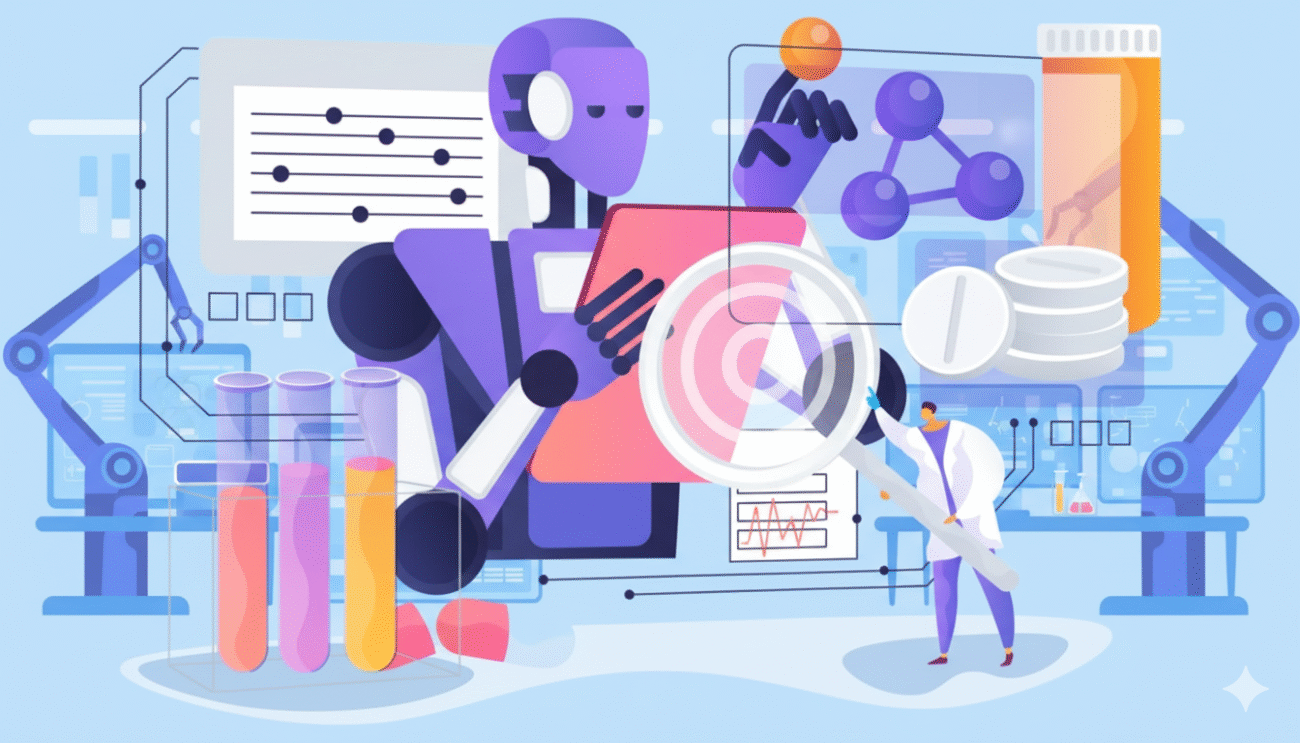
Artificial intelligence (AI) is reshaping how pharmaceutical sales representatives engage healthcare professionals (HCPs), plan calls, manage territories, and comply with ethical and regulatory standards. Unlike naïve hype, leading commercial AI tools are integrated into industry-specific platforms — powering predictive insights, automated CRM entries, pre-call guidance, compliance checks, and real-time analytics. This transformation occurs within a complex regulatory ecosystem (e.g., Indian marketing codes, U.S. FDA guidance) that demands accuracy, transparency, and safety.
This article provides:
- Current market landscape and tool categories
- Hard adoption data and industry examples
- Regulatory frameworks and compliance constraints
- Expert viewpoints on risks and implementation
- Actionable insights for sales leaders
1 — Context: AI’s Commercial Value in Pharma Sales
AI represents not a future possibility but a present commercial force multiplier in pharmaceutical field operations. Analysts estimate AI applications could create between $350 billion and $410 billion in annual value for pharma companies by transforming sales, marketing, operations, and clinical analytics. But value only materializes when tools are integrated with disciplined governance, commercial compliance, and field workflows.
Core commercial benefits include:
- Predictive analytics — ranking accounts by likelihood to prescribe based on historic behavior and external signals.
- Sales intelligence — suggesting next-best actions tailored to individual HCPs.
- Workflow automation — reducing manual CRM entry, scheduling, and record updating.
- Compliance safeguards — real-time flagging of non-compliant language in sales communications.
2 — AI Tool Categories for Pharma Sales Teams
AI tools for sales reps fall into five core categories — each driving measurable outcomes when implemented responsibly:
2.1 AI-Powered CRM and Commercial Platforms
AI-enabled CRMs integrate data, insights, and guided execution into the rep workflow. Most pharma field teams now work inside these platforms to plan, perform, and record interactions.
Pharma-Focused CRM Suites
- Veeva Vault CRM | Deep Sales and AI Integration
Veeva commands roughly 80% of the global pharmaceutical field force CRM market and embeds AI “agents” that assist reps with planning, data capture, compliance verification, and content retrieval. Key AI features include:- Pre-call Agent: extracts signals from CRM and external data to suggest high-impact activities.
- Free Text Agent: flags possible compliance issues in call notes.
- Voice Agent: turns spoken words into structured CRM entries.
- Media Agent: locates relevant approved content for talks.
All agents are available free through 2030 — signaling vendor confidence in adoption.
- IQVIA Orchestrated Customer Engagement (OCE)
Combines CRM with proprietary prescription and claims data, offering next-best-action insights and dashboards tailored to pharma commercial needs. Integrated analytics help align multichannel engagement with performance KPIs.
Business value:
AI-enabled CRMs accelerate call planning, minimize administrative overhead, and give reps context-aware recommendations — directly impacting productivity and engagement rates.
2.2 AI Analytics, Field Intelligence, and Lead Scoring
Beyond CRMs, specialized tools help reps interpret large, messy commercial and scientific data sets:
Types of capabilities:
- Predictive lead scoring: algorithms estimate an HCP’s likelihood to adopt a therapy based on multi-fidelity data.
- Territory intelligence: real-time dashboards reveal prescribing shifts, competitive signals, and unmet needs.
- Insight extraction: natural language processing (NLP) pulls actionable signals from scientific literature, conferences, and regulatory filings.
Research Example:
Academic models like SalesRLAgent — a reinforcement learning AI — showed ~96.7% accuracy in real-time conversion prediction in simulated sales conversations, outperforming baseline models by 35% and boosting conversion when integrated with CRM tools.
2.3 AI Agents and Virtual Assistants
AI agents perform routine workflows or act as intelligent assistants to reps.
Examples include:
- Automated outreach agents — craft personalized follow-ups and alerts.
- Conversational assistants — answer instant questions, schedule calls, or pull CRM data.
- Automated data capture — transcribe meetings and populate CRM fields without manual entry.
Emerging platforms allow companies to build custom agents mapped to commercial strategies and compliance policies, enabling tailored automation at scale.
2.4 Domain-Specific Intelligence and NLP Tools
Tools that specialize in domain analysis — extracting insights from complex unstructured sources:
- NLP platforms scan clinical trials, regulatory decisions, and scientific publications.
- These tools surface market trends, competitor activity, and clinical insights relevant for field messaging.
- By transforming long texts into structured commercial intelligence, they help reps stay updated and credible in technical discussions.
2.5 Compliance and Regulatory AI Systems
Regulation remains a top risk area. Advanced systems assist compliance teams — including flagging unapproved messaging, guiding documentation workflows, and mapping new AI governance requirements.
Notable research:
RegGuard — an AI assistant designed to automate interpretation of evolving regulatory text with audit trails and traceable provenance — underscores the potential for AI to support compliance at scale.
3 — Adoption Metrics and Industry Footprint
AI penetration in pharma field operations has accelerated due to three key forces:
- Competition among CRM providers integrating AI features.
- Commercial leaders demanding predictive sales intelligence.
- Artificial intelligence moving from experiment to enterprise standard.
Market Share Highlight
- Veeva Vault CRM: ~80% global market share in field force CRM.
Adoption Indicators
- Multiple CRM platforms (Zoho, Microsoft Dynamics, Insightly) report AI automation features like meeting transcription, task recommendations, and data hygiene enhancements — indicating broad tech trends across sales sectors.
4 — Regulatory Landscape Impacting AI Tools in Pharma Sales
Pharma sales operations are uniquely regulated because they intersect commercial influence, patient safety, and professional conduct. AI tools cannot be deployed in isolation; they must operate within enforcement frameworks that govern promotional activity, privacy, medical advice, and data use.
4.1 Ethical and Marketing Codes in India and Abroad
India’s Uniform Code of Pharmaceutical Marketing Practices 2024 sets ethical guidelines for interactions between reps and HCPs, covering promotional materials, gifts, educational events, and sales conduct. This code — now with quasi-statutory status — applies equally to new AI-enhanced messaging and content generation.
Similar voluntary/industry codes exist globally:
- PhRMA Code (U.S.) — Industry-led guidance on ethical promotion to HCPs.
- EFPIA and ABPI codes (EU/UK) — Govern ethical engagement and disclosure practices.
Key implications for AI tools:
- Generated messages must align with approved indications and risk disclosures.
- Automated outreach must respect professional boundaries and consent.
- AI planning cannot substitute for qualified medical judgment.
4.2 AI and Healthcare Regulation in the U.S.
While there is no specific federal law exclusively for AI, AI systems used in healthcare and life sciences intersect with multiple regulatory regimes:
- FDA Draft Guidance (2025) outlines recommendations on using AI/ML to support regulatory decision-making and risk-based oversight across product life cycles.
- Privacy and data protection: systems must comply with HIPAA and other data governance frameworks — especially if processing personal health information.
These constraints influence tool design — companies must maintain transparency, explainability, and audit trails to ensure regulatory compliance.
5 — Implementation Challenges and Risks
Integrating AI into pharma field operations improves performance but introduces unintended risks:
5.1 Regulatory Compliance Risk
- Potential for AI to generate non-approved messaging demands strict content governance.
- Systems must embed pre-approved message libraries and compliance rules to avoid regulatory infractions.
5.2 Data Quality and Bias
- Poor data leads to inaccurate recommendations or misprioritization.
- Bias in training data can skew targeting toward inappropriate segments — necessitating careful supervision.
5.3 Ethical Concerns
- Sales leaders must balance commercial optimization with ethical conduct.
- AI should augment human judgment, not replace relational expertise or clinical knowledge.
6 — Expert Insight: Commercial Leaders Speak
Commercial Digital Officers and field systems experts emphasize:
“AI agents in CRM will drive efficiency by enabling reps to focus on value-add interactions rather than data entry.”
— Director, Field Systems & Projects at a Top-10 pharmaceutical company.
Industry analysts agree that domain specialization matters: AI built into life sciences CRMs — with compliance controls and medical context — outperforms generic tools.
7 — Best Practices for Sales Leaders
To maximize ROI and minimize risk, leaders should:
1. Align AI deployment with compliance frameworks
- Embed regulatory and ethical rule sets into AI prompting and outputs.
- Maintain audit logs for all AI-generated content.
2. Invest in data governance
- Clean, unified HCP profiles across CRM, claims, and prescribing data.
- Daily refresh cycles to prevent outdated recommendations.
3. Train sales reps and MLR teams
- Educate on AI tool capabilities, limitations, and compliance obligations.
4. Evaluate impact quantitatively
- Define performance KPIs such as call effectiveness, conversion rates, and engagement depth.
8 — Future Outlook
Looking ahead, four trends will shape AI usage in pharma sales:
Trend 1: Integrated Decision Support
AI recommendations will move beyond simple predictions to context-sensitive next steps across field, marketing, and payer interactions.
Trend 2: Explainable AI and Regulatory Transparency
Regulators will increasingly demand models with explainable reasoning and traceability, especially for high-impact decisions.
Trend 3: Cross-Functional Intelligence
AI systems will unify sales, medical science liaison insights, and commercial analytics — enabling more sophisticated targeting and engagement strategies.
Trend 4: Responsible Automation
Governance frameworks will evolve to mandate human oversight in all AI-driven sales decisions.
References
- Best AI Platforms for Pharma Field Force Analytics — Tellius analysis of CRM and field tools, including Veeva’s 80% market share and AI agents. https://www.tellius.com/resources/blog/best-ai-platforms-for-pharma-field-force-effectiveness-in-2026-10-platforms-compared
- Veeva Vault CRM product details — deep life sciences CRM with built-in AI agents. https://www.veeva.com/products/crm-suite/crm/
- FDA Artificial Intelligence guidance overview — regulatory context for AI use across drug development and related fields. https://www.fda.gov/about-fda/center-drug-evaluation-and-research-cder/artificial-intelligence-drug-development
- Uniform Code of Pharmaceutical Marketing Practices 2024 — India’s updated ethical marketing code. https://en.wikipedia.org/wiki/Uniform_Code_of_Pharmaceutical_Marketing_Practices_2024
- Zoho CRM and AI capabilities — example of CRM AI integration. https://en.wikipedia.org/wiki/Zoho_CRM_%28application%29
- SalesRLAgent research — academic insight into sales optimization with reinforcement learning AI. https://arxiv.org/abs/2503.23303
