 US Pharma Marketing
How new research on patients, providers, and marketers points to a more connected model of virtual care
For years, healthcare has treated telehealth, patient portals, text reminders, and email follow-up as separate tools, each planned, bought, and measured on its own. But patients do not experience virtual care as disjointed, separate channels. To someone managing a chronic condition or waiting on specialist care, these channels are how they connect with their provider before, during, and after a visit.
That shift matters for pharma marketing teams building their 2027 plans. The Virtual Care in America: The Populus Report published in coordination with DHC Group, PM360, and Researchscape International, surveyed more than 1,000 patients, 125 providers, and 63 pharma marketing professionals about how virtual care functions today.
The surveys were fielded between February and March 2026, drawing on the perspectives of patients, providers, and marketers side by side. Three findings from that research point to where digital health and telemedicine integration is headed next.
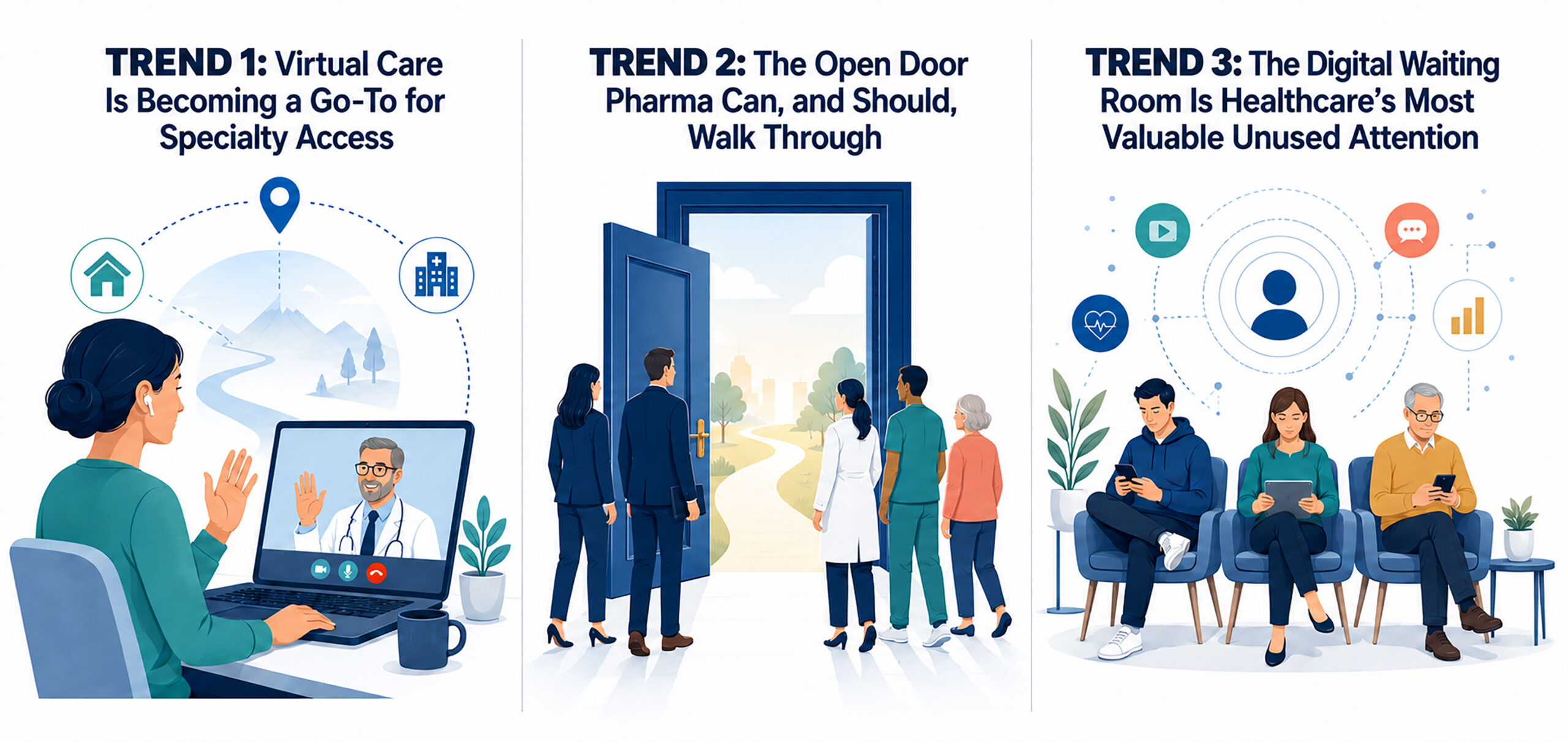
TREND 1: Virtual Care Is Becoming a Go-To for Specialty Access
Virtual care has moved past convenience. For many specialty patients, it has become the difference between receiving care and going without it. The report found that 70% of cardiology patients, 73% of obstetrics-gynecology (OB-GYN) patients, and 78% of neurology patients would have delayed or skipped care entirely without a virtual option. What’s more, one in 10 patients said they would not have sought treatment at all. In total, 56% said they would have eventually seen a doctor in person, which still means care was delayed.
Providers reported tangible benefits to using virtual care. 73% say virtual care decreases treatment delays, and 68% say it gives patients access to specialists who are not available locally. 83% already use virtual care for at least some patient interactions, and more than a third rely on it for half of their interactions or more.
Pharma marketers see the same access benefit from a different angle: 79% said virtual care accelerates treatment initiation, and 72% said it outperforms in-person settings for reaching underserved populations, including patients in rural areas without a local specialist.
What these findings show is that health systems use virtual care in day-to-day patient management across chronic conditions and consider it core access infrastructure. For pharma marketers, that highlights the need to build brand plans that incorporate virtual care as an essential component of overall patient journey engagement rather than around individual traditional channels.
Therapeutic areas with high specialist scarcity, including cardiology, OB-GYN, and neurology, are where a virtualfirst approach will reach the most patients who would otherwise delay treatment. Rural and underserved markets deserve particular attention, since providers and marketers agree virtual care identifies patients in need of care more effectively than in-person channels alone.
Timing matters as much as targeting. Brand teams have traditionally relied on behavioral data that loosely identifies patients well before a potential care moment, or claims data that lags the care moment by a month and a half or more. Real-time clinical signals, such as diagnostic codes and lab orders or NDC codes for prescriptions written, fire at the moment care is happening rather than long before or after it. Brands that can act on those clinical signals reach patients while a treatment decision is still being made, not after the care decision is made or at another time completely.
The opportunity to offer synchronized HCP and patient engagement is also possible within the virtual care environment. Messaging delivered inside a clinician’s existing workflow based on the same patient ICD 10 and NDC code ensures you are reaching them at the most relevant moment. Offering synchronized HCP and patient messaging ensures that both the patient and the HCP has the most relevant brand information potentially needed for treatment decisions.
“Across all three trends, the same pattern holds: patients are engaged, providers are open, and marketers are investing. What is missing is a shared way to plan across these moments, instead of treating each one as a separate, disconnected tactic.”
TREND 2: The Open Door Pharma Can, and Should, Walk Through
Patients are asking for more support inside virtual care, and providers are largely open to it. Pharma has not yet shown up to meet that openness.
73% of patients said they would find it valuable to enroll in a patient support program during or after a virtual visit. That request builds on a foundation of trust: 88% of patients said they felt safe using virtual care for their healthcare needs, and 86% said they were comfortable discussing personal or sensitive topics through it.
On the provider side, 53% said pharma presence in virtual care is acceptable or helpful. Yet 57% said they rarely or never encounter pharma messaging in virtual care settings at all.
Providers have been clear about what they will accept: education and support that respects the clinical moment. Pharma’s opportunity is to design for that standard directly, rather than defaulting to creative for other digital channels.
At the same time, marketers are not holding back on investment, with 81% reporting they increased their virtual care spending over the past year. Budgets are going up, but arguably most tactics are still planned and bought one channel at a time, rather than built around the moments when patients are actually paying attention, like in patient portals, digital health apps, and inside virtual visits.
This is happening at a moment when several major pharmaceutical manufacturers are building out their own direct-to-patient platforms, giving patients new ways to receive medications and information outside the traditional office visit. Virtual care should also sit alongside this strategy shift as another setting where patients already expect support, education, and follow-up.
The measurement case for increasing investment in virtual care is real. 48% of marketers said virtual care offers better attribution than other digital media channels, and 78% said it offers better return on investment than traditional digital health advertising. The tools to justify greater investment already exist.
Pharma marketers can get better ROI with virtual care investments by sequencing patient support around the actual visit. Enrollment offers, refill reminders, and product information land best after the appointment, delivered through the same portal a patient already uses to review visit notes and message their provider.
“All three are describing the same underlying behavior: a person who stays engaged in their care. Building a shared vocabulary for that outcome is the next step for the healthcare industry.”
Opt-in mechanisms for follow-up text and email keep that outreach permission-based rather than intrusive.
The same discipline applies to physicians. Pharma marketers have the opportunity to place messaging in a provider’s clinical workflow at the point where they are already reviewing a patient’s case. Diagnostic and procedure codes tied to that visit can sharpen the timing and relevance of that message, surfacing it when a specific clinical decision is already underway. Brand teams that orchestrate HCP engagement based on this clinical signal to deliver relevant messaging within and outside the EHR and coordinate it with their field team’s outreach will reinforce a consistent message across both physician and patient touchpoints.
TREND 3: The Digital Waiting Room Is Healthcare’s Most Valuable
Unused Attention Patients waiting for a virtual visit are already paying attention, often more than marketers assume. 51% of patients said they are focused on their screen before and during the appointment. 46% said they would welcome health or educational content while they wait.
That attention is already showing up in how visits themselves play out. 82% of providers cite reduced no-shows as a benefit of virtual care, and providers report a 66% gain in appointment attendance overall. A patient who is present and focused before the visit even begins is a different starting point than the industry has typically planned around.
Marketers have already identified engagement as the metric that matters most for virtual care. 66% rank it as their leading measure of effectiveness, ahead of new patient starts, script lift, and reach. 70% said virtual care is effective for supporting patient education specifically.
The interest in this window mirrors a broader shift already underway in physical care settings. Point-of-care media revenue surpassed $1 billion in 2024 1, up 16% year over year, as marketers moved dollars into waiting room screens and other in-office channels, according to the Point of Care Marketing Association. Virtual care’s pre-visit window represents that same kind of captive attention, but with individual relevant patients based on their reason for visit is an engagement opportunity window still being adopted by pharma marketers.
Patients have been direct about what they want during this window: useful health information, not advertising for its own sake. Marketers who build around that expectation, rather than importing tactics designed for other digital channels, stand to gain the most from it.
The same attention that shows up before the visit continues afterward. Appointment reminders, refill nudges, and program information delivered through a patient’s follow-up channel keep that same person engaged once the visit closes. Tracking engagement across the pre-visit, visit, and post-visit windows gives marketers a fuller measure of effectiveness than any single moment alone.
The Throughline
Across all three trends, the same pattern holds: patients are engaged, providers are open, and marketers are investing. What is missing is a shared way to plan across these moments, instead of treating each one as a separate, disconnected tactic.
Patients, providers, and marketers also describe the value of virtual care in different terms. Patients talk about feeling safe and satisfied. Providers talk about adherence and follow-up completion. Marketers talk about script lift and return on investment.
All three are describing the same underlying behavior: a person who stays engaged in their care. Building a shared vocabulary for that outcome is the next step for the healthcare industry.
Virtual care has become the environment where much of modern patient care now happens, and where pharma’s next opportunity to support patients responsibly is being built.