 US Pharma Marketing
Pharma and Marketing in a New Era
Discussing customer-centricity in the ever-evolving technological landscape of healthcare.
On September 30, 2024, we gathered our 2024 Trailblazer Brand Champions and Marketer of the Year for a roundtable discussion sponsored by Concentric Life, centered mainly around customer- versus product-centricity in our industry, AI and technological implementation in marketing and pharma, patient empowerment strategies, cross-functional collaboration, social listening, data-driven decision making, and more. The discussion was moderated by Croom Lawrence of Acurist.AI. The Circle of Excellence 2024 Round Table participants names are included in the list to below.
MODERATOR
CROOM LAWRENCE
Co-Founder – Acurist.AI
MILANA FOMIN
Director of Marketing – Replimune
MELLISA HUNH
VP, WH Marketing Lead – Sumitomo Pharma America Inc.
ALEX KOOLURIS
SVP, Management Supervisor – ConcentricLife
KATIE LEWANDROSKI
Executive Director, Oncology Marketing Lead – Sumitomo Pharma America Inc.
LALI LOBZHANIDZE
Head & Executive Director, Marketing Strategy – LEQVIO, Novartis Pharmaceuticals
VICKY LOUIT
Director of Medical Marketing – Eucerin Beiersdorf
LINDSEY LOUGHMAN
Associate Director – Accenture Song
JENNIFER MONAHAN
Associate Director – Oncology, Renegers
JENNIFER NOVAK
Director, Consumer Digital Marketing – Sanofi
FLOREN ROBINSON-PRESSMAN
Accenture Song
MARC RUSSO
Director, Interstitial Lung Disease Marketing – Boehringer-Ingelheim
JENNIFER SPEVAK
Director, Vaccines Portfolio Adherence – Pfizer
LIZ TEMPESTA
Senior Director, Consumer Marketing, Eye Care Division – Viatris
ANIT VAHIA
Chief Strategy Officer – ConcentricLife
Croom Lawrence: The best way to kick off the roundtable is to define being customer- centric. That’s easy enough, right? Our customers are going to get personalization, whether we give it to them or not. They’re going to have [access] to AI superpowered bots.
Vicky Louit: We’re [remaining customer-centric] by trying to meet dermatologists where they are. And one of those things is obviously digitally, which I think is no surprise to anybody else, but also socially. We established a professional LinkedIn channel, so we can actually talk to our HCPs and communicate with them directly, versus what you normally see at an OTC company. We’ve created an area where we can communicate professional information like data, but also publications and other things that are happening within our company, which I think is relatively unique for industries like ours.
Liz Tempesta: I work in the ophthalmology space, and I work on a product that’s a nasal spray for dry eye. It’s particularly challenging because we are talking to prescribers who are eye care professionals, and they don’t know about the nose. So, it’s really interesting to try to create educational tools and use different technologies to help educate the HCP. Our focus has really been, in addition to trying to find novel ways of doing that, also trying to elevate the patient voice and make some connections for them, as to why they’re suffering from dry eye.
One of the initiatives that we’re working on is making the connection between menopause and dry eye, which is often not talked about because…hormonal changes aren’t really top of mind for the eye care professional, and a PCP is not going to prescribe a drug for dry eye. What we’re trying to do is connect with a patient, really elevate some connections around why they may be experiencing dry eye, but then also on the HCP side, trying to create educational tools that can help them have conversations with their patients.
We have all sorts of both physical models, digital types of tools that talk about MOA and really help unpack the MOA of our particular product.
But then on the patient side, it’s about trying to help the patients understand a little bit more about the disease and help empower them to have conversations with different types of practitioners or clinicians around their experience. We’re trying to bring those stories to light. We know that women’s health often gets pushed down. A lot of conversations don’t happen. So, we’re trying to elevate that conversation, bring that patient voice to the surface—ultimately to empower them.
“We know that women’s health often gets pushed down. A lot of conversations don’t happen. So, we’re trying to elevate that conversation, bring that patient voice to the surface…”
Lindsey Lougman of Accenture Song (left) and Milana Fomin of Replimune.
Jennifer Spevak: I work in the vaccine space and it’s just a little bit different, especially since we focus on the business of prevention versus treatment. This requires a different mindset when you think about customer-centricity, since you are looking to inspire action from potentially healthy individuals. When I think about customer-centricity, I look at it not only from the HCP perspective, but also from the patient perspective. I try to think through, what are some of those challenges or barriers that our patients are facing when it comes to vaccination?
In general, when it comes to vaccination and patient perspective, it comes down to information about vaccines and a recommendation from a trusted source. Asking questions like: Where are patients finding information that resonates with them? Who are their trusted sources or trusted voices? What type of information is more impactful to a patient’s vaccination decision?
Taking the answers to these questions into account and then trying to combine vaccine content along with information that addresses their hesitancy into resources, can help both HCPs and their patients. By blending both customer- and patientcentricity into our work, we can help to make resources more personalized.
Liz Tempesta: Every year, there’s a new trend, whether it’s omni-channel, or AI. I think we get stuck on these trends, or the platforms we need to be on. We need to get on Reddit, we need to get on TikTok. Then we go platform first, or technology first, without really thinking about how we are doing it or what the profile of the person using that platform is. How are we adapting our content to meet them in an authentic way? Because more and more, these very platforms that we are going to place a high value on authenticity. And that’s kind of the challenge. You want to make best use of the shiny new thing, but you also have to be really grounded in certain things that don’t change about patients.
Jennifer Novak: Customers are also searching and seeking information on all these different platforms, like TikTok and Reddit, using them like traditional search engines. There’s a lot of misinformation out there, but patients are becoming a lot savvier about how they might want to treat what’s going on with them before they even get to the office. We have to maintain authenticity on those channels, with content that resonates with their lifestyle, background, and culture— also, featuring HCPs on Tik Tok—to bring credibility and authority to platforms where it’s missing in a lot of cases. That’s how we’re trying to cut through the clutter, again, with authentic patient voices and physicians.
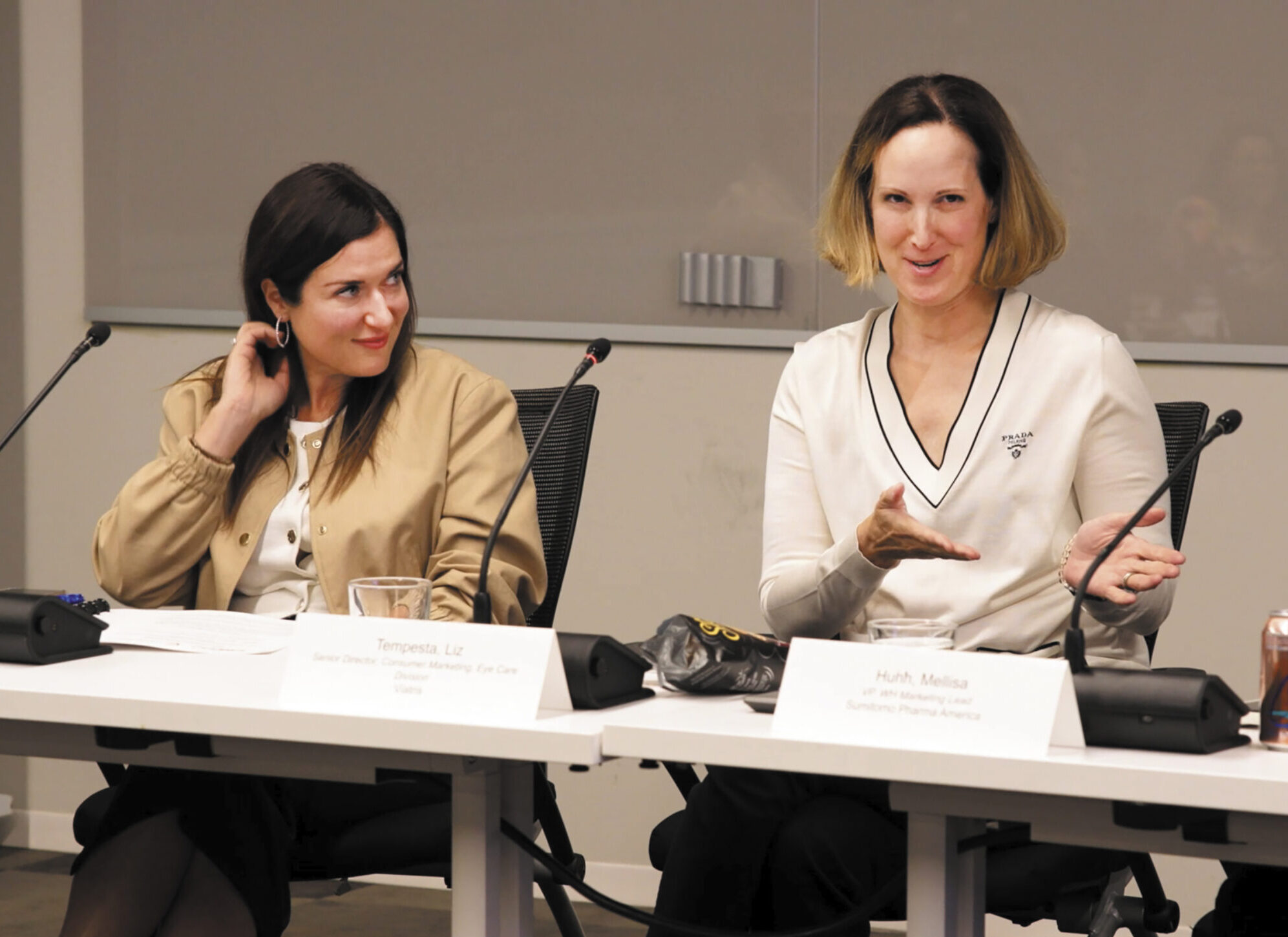
Milana Fomin of Replimune (left) and Liz Tempesta of Viatris.
Croom Lawrence: The currency of leadership for everyone in this room is really being an advocate for the customer, being the customer in the room, finding the insights, and activating on that. How do you handle that organizationally? So, you’ve had an amazing discovery on an insight, you want to champion that in, brief it in, protect it; but is there organizational support or is there friction?
Lali Lobzhanidze: I believe every marketer experiences moments where we either find ourselves selling an insight or fortunate enough to engage in strong co-creation, leading to effortless adoption. Organizationally, a key question is determining how we treat an insight. Are we aiming to assert the insight as the definitive answer, or should we consider it as a hypothesis to test and validate? By treating insights as hypotheses, we embrace continuous learning and validation.
As we gather new information, we evolve our hypotheses, fostering a culture of scientific thinking within the organization. Collaboration is vital in this process. When different teams come together— engaging in robust discussions about behaviors and underlying biases—we achieve collective ownership of ideas. Cocreation can be challenging, but when done effectively, it empowers the organization immensely.
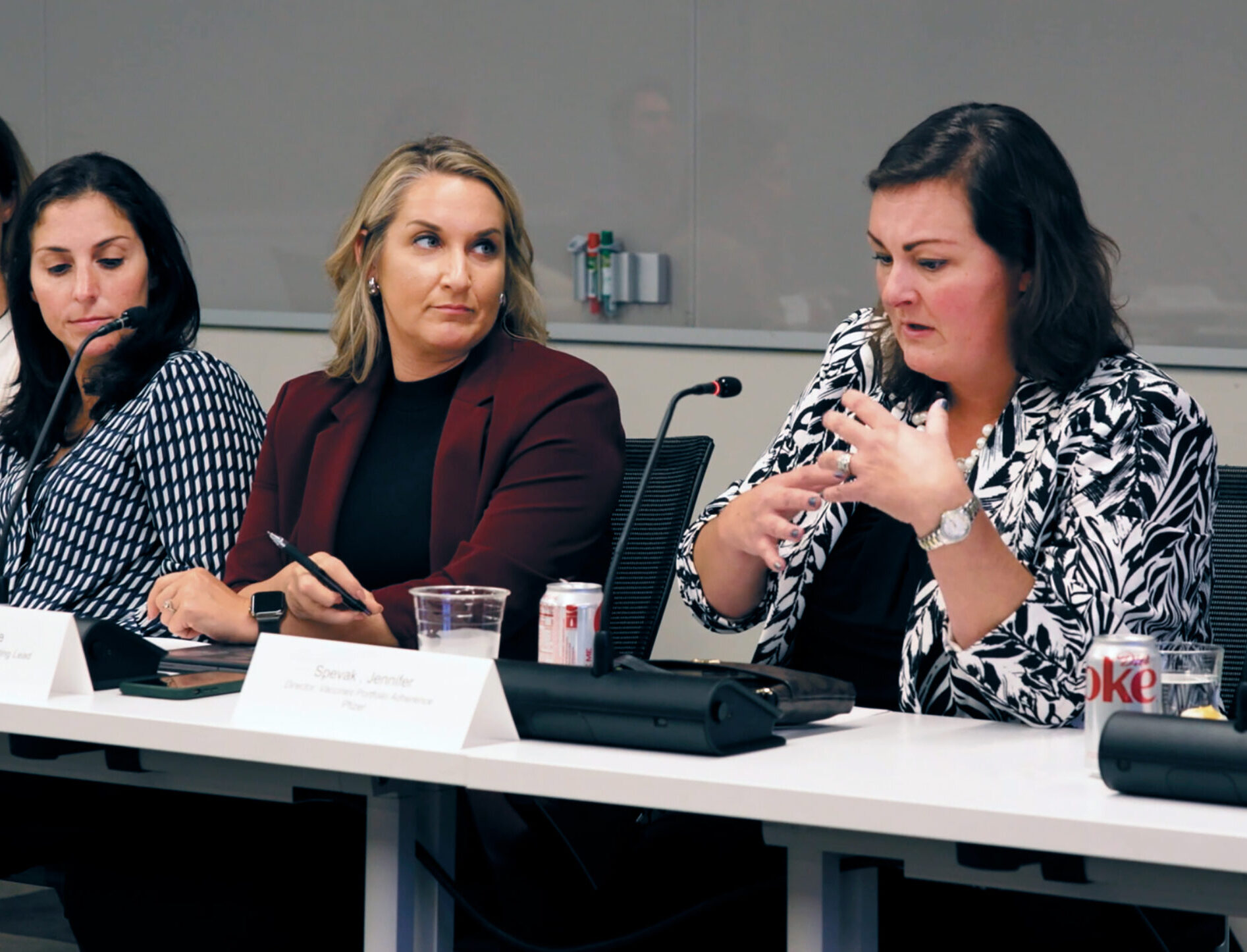
Left to right: Mellisa Hunh of Sumitomo, Katie Lewandroski of Sumitomo, and Jennifer Spevak of Pfizer.
Croom Lawrence: How soon do you need to bring the commercial team in on a launch? Because strategy is being made way in advance, at the time the label is being written, the phase three trials, then the positioning is locked, [figuring out] what it’s going to do in market, what the final drug is going to be. The commercial steps are often pushed a little bit later, but how early do you want to be brought in to bring those insights forward? Because it’s not just about the labels; there are a lot of other factors in play.
Floren Robinson-Pressman: My greatest hope for this industry is to find a model where Clinical Trials, Patient Services, and Commercial can seamlessly work together to share insights, capabilities, and priorities from the beginning of this process.
The patient who engages with us is the same person whether they are participating in a clinical trial or simply trying to find the right treatment, get on it quickly, and stay on it. As a group, we could be so much more effective as advocates for that patient (and empower caregivers) if we collaborate in new ways. So, the conversation will be less around “when does the commercial team join” and more about “did you know this about our patient (whose quality of life we are working hard to improve).”
Technology and data will make this even easier, but organizationally, we need to align that this is the right way of working—breaking down siloes organizationally and culturally and aligning how people are measured with a long-term and short-term patient mindset. By bringing this together, we can offer a better end-to-end experience, an increase in ROI, and improved patient outcomes.
Lali Lobzhanidze: Clinical trials design has a huge impact on our ability to maximize growth and impact for patients, and it reflects how we understand our customers’ needs. Involving the commercial team early in the process—even for co-creating early phase trials—can be extremely beneficial. At Novartis, we typically assign a marketer to the brand approximately three years before the product launch.
Nonetheless, there is a commercial lead who oversees the business aspects much earlier and starts planning and strategizing in advance to ensure that we are aligned and prepared to meet market demands effectively.
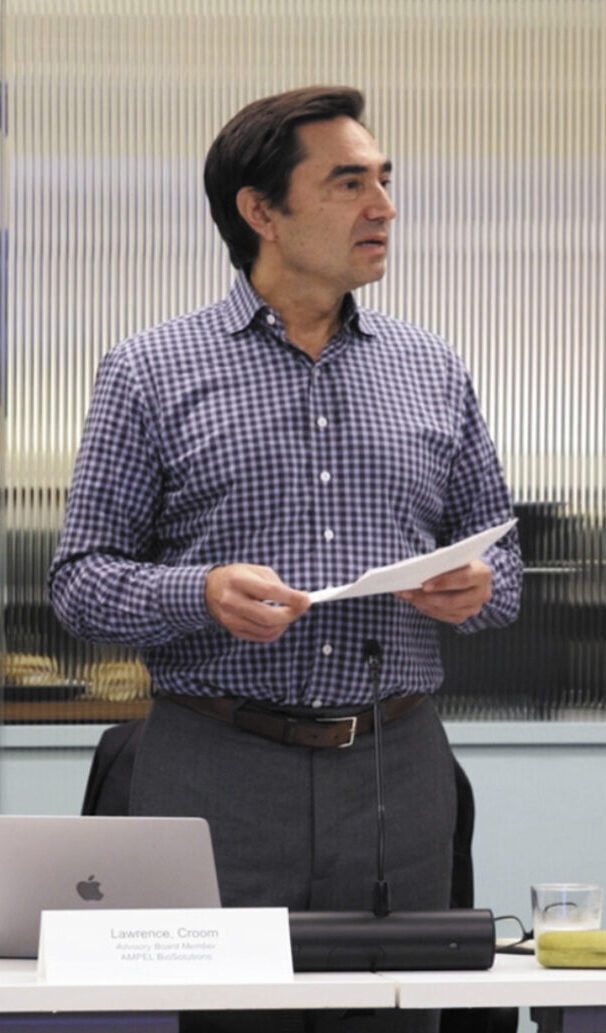
Croom Lawrence of Acurist.AI
Mellisa Hunh: I spend more time celebrating failures than successes, and I think that’s such an important culture: aligning with your team to a vision, and knowing that you’re doing a series of test failures, and even across our brand, we have two indications.
Sometimes things that are right for one indication are not right for the next. And you have to be willing to pivot real-time strategies and align to KPIs that allow you to flex and market. We’ve done that really rapidly with our vendors. We set up favorable terms that allow us to turn things off or switch our strategies.
And right now, you could—with search and other channels—be changing your strategy every two weeks. You don’t want to necessarily, because in the long-term it’s going to be really hard to measure. But I think that, for any launch brand, if you can think with that mindset of failing first, being vocal about it, learning from other brands around you, as well and not being shy to actually put those examples out there, you end up propelling yourself forward. A lot of times, we have that innate nature of kind of hiding those failures, but we try to really propel them forward.
Croom Lawrence: How do you think Artificial Intelligence (AI) changes the role of the agency with your new capabilities? Are you getting the right amount of service from it?
Anit Vahia: It helps make marketing more effective and ensures it stays effective. AI gives us speed and efficiency. For example, if you have four campaigns out there—one is working—we can turn that around.
That is fundamentally what AI needs to do for marketing. Let’s make those changes quick. There’s no hours of Photoshop and Illustrator; we’ve all been through it. Even with market research testing, you can make a pretty good estimate. AI is not going to take over, the sky isn’t falling, but eventually the future [of marketing] is going to be people who know how to use it and use it well.
The other thing [about AI] is something I love—and this is how as strategists love using it—it brings my thoughts to life. I can tell beautiful stories with images. And speaking with clients, they’re like, “Okay, this makes more sense than six bullet points.” It’s an important evolution. And it’s great to hear that we’re all coming together. Because I think efficiency leads to more impactful marketing, not fewer people.
Milana Fomin: I recently heard a podcast that discussed a new technology with generative AI that is analyzing EPIC data. The certain tests are leading to certain diagnoses. For example, let’s use Alzheimer’s: there is an opportunity to start engaging with the doctors earlier on, giving them evidence that the cohort of patients who have certain symptoms and positive tests could get diagnosed with Alzheimer’s in the future. It comes as an early education and the companies that adopt such technologies are building loyalty for the company and the company brands in the future, because they are showing up with credibility and knowledge.
Left to right: Jennifer Novak of Sanofi, Jennifer Monahan of Renegers, Lali Lobzhanidze of Novartis, Anit Vahia of ConcentricLife, and Floren Robinson-Pressman of Accenture Song.
Marc Russo: I wanted to chime in with two areas of success and challenge, in regards to AI, that are really in line with what we were talking about in terms of saving time. One of the biggest advantages we’ve found with AI is its ability to streamline workflows and save customers time in a way that complements their existing processes.
For instance, we’ve had success leveraging AI to identify and manage the challenges with having so much data. AI has identified opportunities in the data for our field teams.
Another way we’ve utilized AI is for content tagging; which helps us with modular content creation. [However], I think we’re struggling with it because we’re still seeing that it requires the time to review and validate the AI. So, you’re not really sure, at the end of the day, how much time is really being saved. We might be saving costs compared to using agencies, but I’m not sure on the time, or that we’re seeing the returns right away. That said, there’s a balance to strike. It’s important to test and learn with AI, in order to help it develop that muscle memory; then [it can deduce that] while this initiative maybe didn’t work, there’s a similar initiative that might work or different content, different stakeholders, or different ways of implementing what would work.
This [point] goes back to our earlier questions around integrating AI while working with large pharma corporations—in rare disease, I believe it can be very challenging to implement any sort of platform or IT capability, primarily because we have to prove the value ahead of time and show long-term benefits, either with other brands in our organization or globally. This can be difficult, especially if you’re trying to test/learn while demonstrating value.
“AI is not going to take over, the sky isn’t falling, but eventually the future [of marketing] is going to be people who know how to use it and use it well.”
Lali Lobzhanidze: One of the challenges with AI is similar to those with pilots, where solutions address specific problems but lack clarity and infrastructure for scaling. Many organizations are establishing governance processes to enable innovation to be scaled effectively. At Novartis, our Innovation Lab plays a crucial role in governing, assessing, and scaling solutions, including AI, allowing us to develop a comprehensive AI strategy and address specific use cases. By fostering a structured yet collaborative environment, we aim to integrate AI effectively.
Jennifer Novak: It comes down to it not being a tactic but being part of a strategy. Sometimes, particularly with the kind of brand planning we do, it becomes as I call it, ‘a content buffet.’ We get pitched tactics, and we try to marry those tactics to organizational objectives. I think it’s important to separate the tactic and the strategy.
Floren Robinson-Pressman of Accenture Song, Croom Lawrence of Acurist.AI, Alex Kooluris of ConcentricLife, Lindsey Lougman of Accenture Song, Milana Fomin of Replimune, Liz Tempesta of Viatris, Mellisa Hunh of Sumitomo, Katie Lewandroski of Sumitomo, and Jennifer Spevak of Pfizer.
“…If you can think with [the] mindset of failing first, being vocal about it, learning from other brands around you, as well and not being shy to actually put those examples out there, you end up propelling yourself forward.”
Croom Lawrence: What is one thing you’ll do going into 2025, to add to your plans?
Jennifer Novak: Dupixent is a big brand with a lot of indications—I really want to work more at that franchise level by leveraging each other’s learning so we can propel the whole brand forward. I want to be a good ambassador to the other indications and facilitate a dialogue where we really learn from each other.
Jennifer Spevak: I would love to continue to support using generative AI to take administrative tasks off my plate and to make room for meaningful work. I’m sure all of you are facing the same things, which is being asked to do more with less. So, my goal is to see how I can use it for simple tasks. And then once I am comfortable and confident with it, seeing how I can really start to apply it in areas more specific to our roles.
Mellisa Hunh: I want to continue to learn from non-pharma trends. Because sometimes I feel like we just get so stuck in our limitations that it prevents us from actually being innovative, [then] use that to stoke and provoke in our company. There is a willingness to do things differently.
Vicky Louit: I want to improve ways of working with MLR. The other thing is really considering [utilizing] patient opinion leaders; I’m looking to explore that further.
Marc Russo: Ruthlessly prioritizing while leveraging both existing and emerging technologies is key. As marketers, we have so much on our plates, and it’s essential to find the best ways to maximize our time so that we can focus on what we really need to do. Striking that balance is my goal.

PM360 thanks to ConcentricLife for sponsoring the Trailblazer Brand Champion Circle of Excellence.