 US Pharma Marketing
Accelerating the Path to Treatment by Leveraging AI for Unprecedented Automation and Acceleration
Time isn’t an abstract KPI in clinical development. It’s the distance between a protocol on paper and a patient receiving a therapy. Yet, when organizations talk about “speed” and accelerating trials, the conversation often centers on execution: automating tasks, improving workflows, or finding ways to move faster once a study is underway.
The reality is that many of the factors that determine a trial’s timeline are established long before execution even begins. Protocol design, site strategy, enrollment assumptions, and operational feasibility decisions quietly shape how efficiently a study runs and its resilience when conditions inevitably change. When those assumptions miss the mark, the consequences cascade across the trial, leading to amendments, delays, and increasing operational complexity.
This is where one of the most common misconceptions around automation emerges. Too often, organizations treat automation as a way to speed up isolated tasks. This means automating small parts of a much larger system when the real opportunity lies in rethinking the system itself. The fastest path from trial to treatment is not executing incrementally faster, but building smarter foundations from the start.
AI shifts this balance by enabling teams to work with a more complete and dynamic view of a study before it begins. Instead of relying on static assumptions, organizations can build digital representations of a trial, often referred to as virtual twins, to simulate how design choices will perform in the real world. In this model, acceleration is not achieved at execution, but embedded at the foundation.
AUTOMATION: From task-level efficiency to system level design
Automation in clinical development has traditionally focused on digitizing manual steps, reducing administrative effort, and improving workflow efficiency. This approach has largely emphasized task-level improvements such as automating data entry, streamlining handoffs, and accelerating reporting cycles. While valuable, it often left the underlying structure of the trial unchanged.
With the introduction of AI-enabled capabilities, automation is becoming more systemic. The shift is no longer just about executing existing tasks faster, but about rethinking how work is structured and how decisions are made at the outset. The goal is to reduce rework, the coordination burden, and repeated decision-making across the entire study lifecycle.
Many delays stem from fragmentation: disconnected systems, misaligned data, and handoffs that slow decisions. Traditional automation improves steps, but doesn’t remove structural friction.
AI gathers information from different sources and makes it easier for teams to access relevant insights. With the right safeguards in place, such as validation checks, transparency, and clear decision frameworks, AI becomes more than a tool for efficiency. It can help reduce errors, improve the quality of decisions, and cut down on the rework that often slows progress.
The misconception is that acceleration comes from doing the same work faster. Many organizations are taking the wrong path to acceleration by focusing on incremental task automation when a faster path exists upstream.
LOOKING AT THE FOUNDATIONS: Study build and virtual twins
The real leverage point is the study build phase where protocols, eligibility criteria, visit schedules, and operational assumptions are defined. AI enables a shift from static study design to dynamic modeling through virtual twins of trials. These models allow teams to test how design decisions will behave before a patient is even enrolled. Eligibility criteria can be stress-tested against recruitment pools, site strategies can be evaluated for feasibility, and operational assumptions can be validated against real-world constraints.
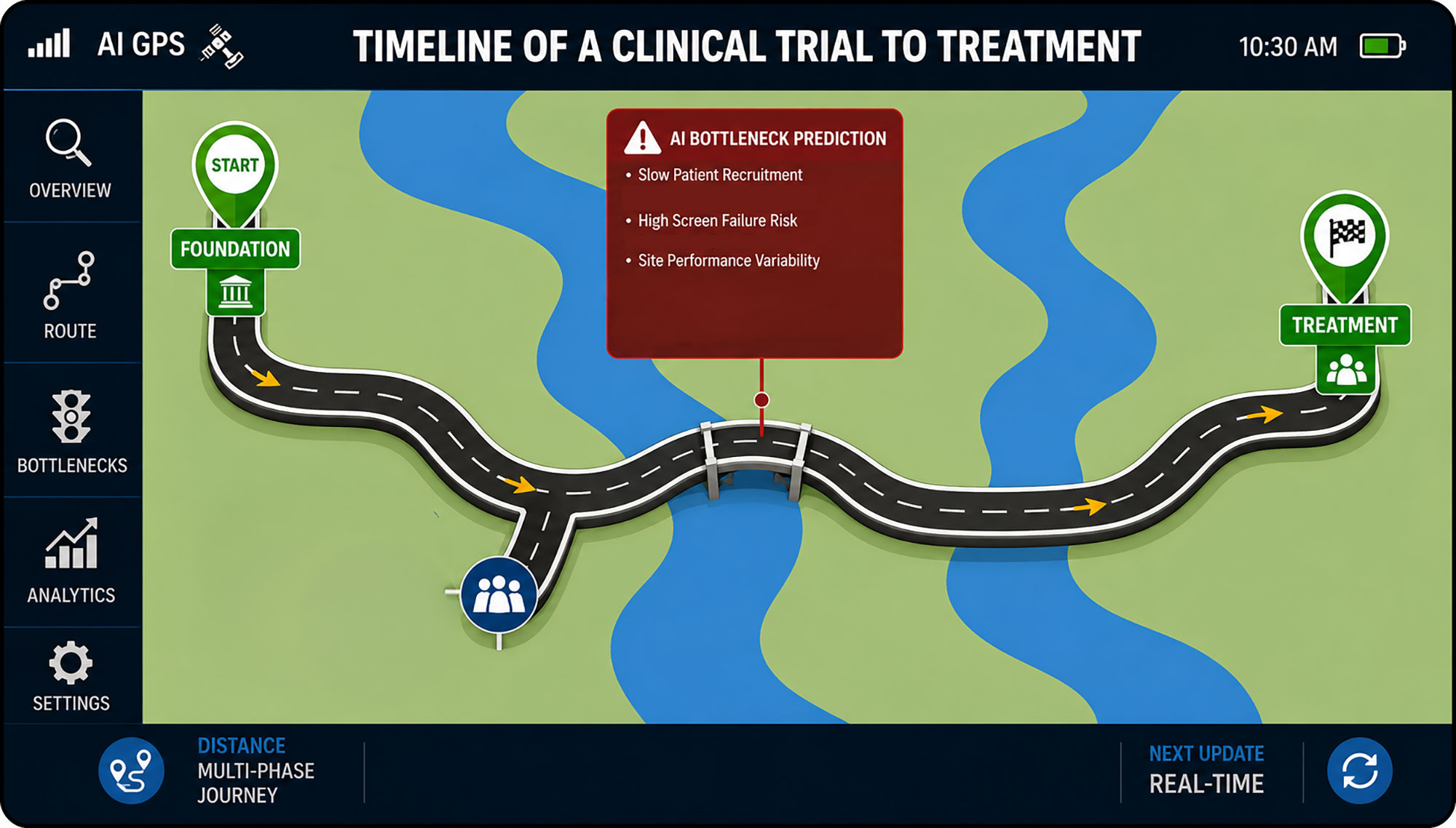
Teams can anticipate where bottlenecks are likely to emerge, whether in recruitment capacity, site burden, data flow, or patient complexity. Protocols can then be designed around these constraints rather than in tension with them, making trials more resilient and requiring fewer downstream corrections.
This reframes study design from a set of isolated choices into a connected system. Every decision influences another, and together they determine whether a trial will run smoothly or accumulate friction over time. When friction is identified early, it can be simplified, rebalanced, or removed before it becomes embedded in execution.
CONDUCTING THE TRIAL: Execution with real-time intelligence
Once a trial is underway, variability becomes unavoidable. Site performance differs, enrollment rarely progresses evenly, and patient behavior often diverges from initial assumptions.
This is where AI extends beyond design into execution intelligence. It provides continuous visibility into trial performance as it unfolds, not just at periodic checkpoints. Signals such as enrollment pace, site activation progress, data latency, and protocol deviations can be monitored and acted upon in near real time.
More importantly, AI helps interpret those signals in context. A slowdown in enrollment may stem from very different causes depending on whether it is isolated to specific sites, concentrated in certain regions, or tied back to a design assumption made during protocol development. Distinguishing between these scenarios is essential because it determines whether the right response is operational or structural.
At this stage, much of the hard work has already been done. Because the system was designed with better foresight at the beginning, fewer interventions are required during execution. Instead of reacting to compounding issues, teams are refining a more stable foundation.
The result is acceleration, not through constant intervention, but through reduced disruption.
THE FUTURE OF ACCELERATION IN CLINICAL DEVELOPMENT
Organizations that can effectively use AI to reduce uncertainty, identify constraints earlier, and build more structurally resilient trials will emerge as clear leaders in clinical development. This requires a shift in mindset: automation is not something applied during execution, it is something designed into the system from the start.
“Teams can anticipate where bottlenecks are likely to emerge, whether in recruitment capacity, site burden, data flow, or patient complexity.”
The impact is clear when assessing AI deployment today. Early adopters¹ of this technology experience overwhelming improvement in trial timelines and reduction in protocol deviation. That’s because faster trials result from making better decisions before delays take hold, maintaining visibility as conditions change, and responding with precision when they do.
Ultimately, speed is not the objective on its own. Each delay in clinical development extends the time between scientific discovery and patient access. By reshaping how trials are designed, simulated, and executed, AI can help reduce that distance and bring new therapies to patients sooner.