 US Pharma Marketing
Why Pharma Can’t Afford to Ignore Clinical Wearables
Not long ago, if you raised the topic of wearables in a serious clinical setting, you’d get a polite smile and a quick subject change. The prevailing wisdom was that fitness trackers were fine for counting steps, but had no place in real medicine. The idea that a sensor on someone’s wrist could generate clinically meaningful information felt, to most serious researchers, like wishful thinking.
Cue better sensors, smarter algorithms, more rigorous validation and a regulatory environment that caught up with the science. These forces converged and accelerated together. Wearables have moved from the wellness aisle to the clinical setting faster than most people anticipated and the implications for drug development and commercialization are profound.
The Inflection Point
Wearable-derived data is now being incorporated into clinical trials as legitimate, FDA-acknowledged endpoints.
A recent analysis in Nature Reviews Drug Discovery catalogued more than 1,000 interventional drug trials registered between 2001 and 2025 that incorporated wearable-derived data and found that the pace of their use is accelerating. Industry analysts broadly expect the first drug approval supported by a wearable-derived primary endpoint within the next two to three years.
The Measurement Revolution
The question is no longer what clinical wearables can measure but rather what they can’t—and that list is shrinking fast. The remaining constraints are largely about training the algorithms, validating the signal, and building the regulatory evidence base.
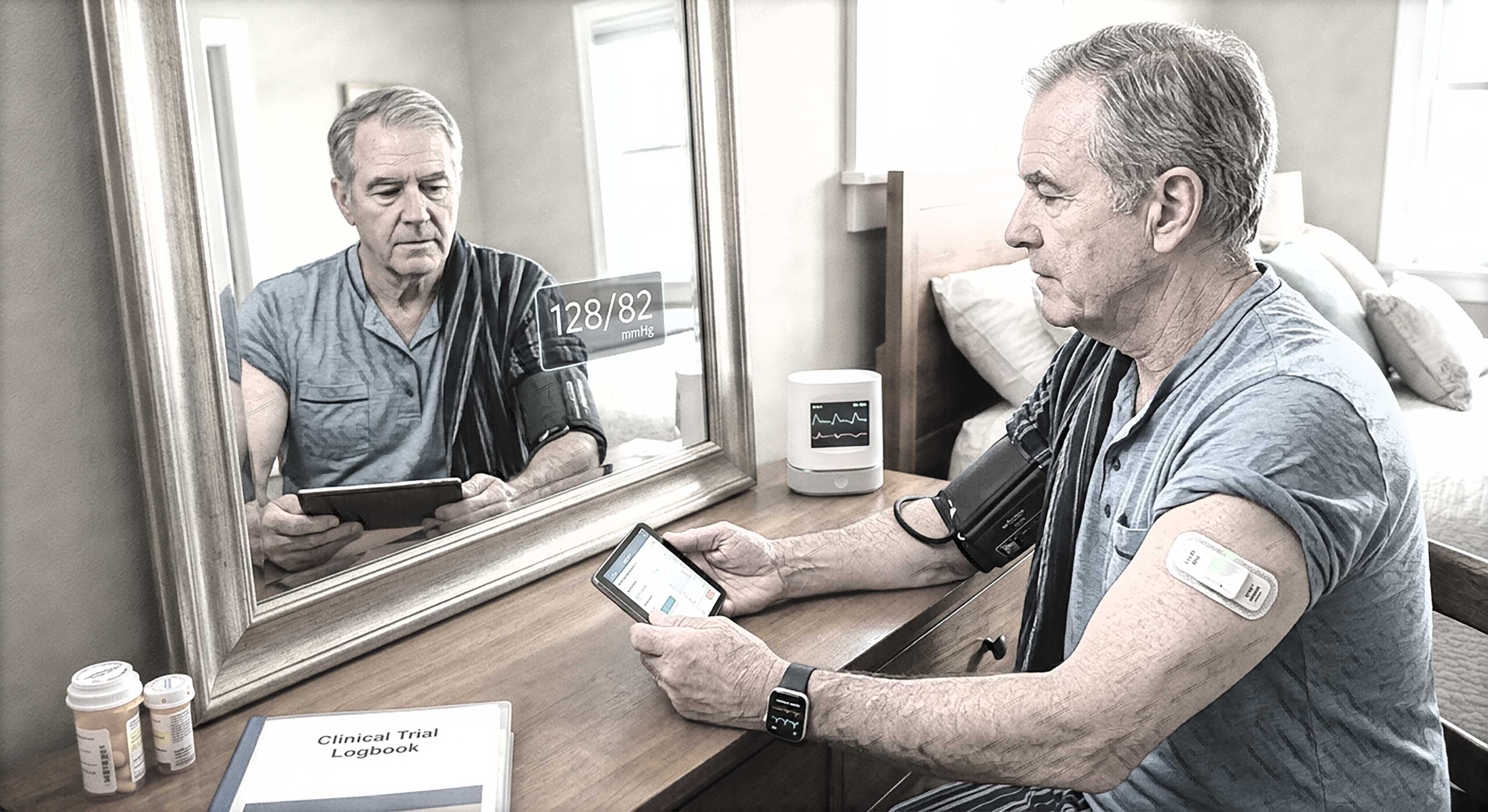
Cardiac monitoring was the first domain to mature and it’s still advancing. Multiparameter patches and biosensors now deliver continuous, clinical-grade ECG, blood pressure, respiration rate, and oxygen saturation on a patient going about their daily life. One company in our portfolio has built a wearable platform specifically for continuous vascular health and hemodynamic monitoring, generating data previously available only in a cardiology lab—data that directly supports hypertension management, heart failure drug titration, and realworld evidence generation. Another company we’ve supported takes a different approach: purpose-built sensors for heart failure that go well beyond what any general-purpose wearable can deliver.
Metabolic monitoring is expanding well beyond diabetes. Continuous glucose monitors were the first breakthrough but the scope has grown. One company we work with has developed a non-invasive sensor that uses light—no needle, no blood draw—to continuously measure plasma volume and hematocrit.
For cardiometabolic and renal drug development, the implications are significant. Safety signals that previously required repeated lab visits can now be captured in real time.
Neurology is arguably the most exciting frontier and the one where pharma has the most to gain. Central nervous system (CNS) drug development has long suffered from a measurement problem. Too much of what matters—how a patient feels, how their cognition is functioning day to day—is captured through patients’ own reports or episodic clinical assessments.
A neurologist sees a patient for 45 minutes and draws conclusions expected to hold for the next six months. One platform in our portfolio uses wearable-enabled diagnostics to generate objective neurological assessments and produces the kind of continuous digital biomarkers that CNS trials have desperately needed.
Another company uses wearable imaging and vision-based technology to capture neurological and ophthalmic data points that, until now, have been inaccessible outside a clinical setting.
Mental health monitoring is at an earlier stage but accelerating. Physiological signals such as heart rate variability, sleep architecture, and movement patterns are passive, objective proxies for mental states that patients previously had to self-report.
Machine learning models trained on these signals have exceeded 90% accuracy in anxiety detection in research settings. Clinical deployment is still catching up but the science is real.
In oncology, wearables are proving their value in tracking functional status, including how patients are tolerating treatment between clinic visits. Activity data from research-grade wearables is now correlated with treatment completion rates, hospitalization risk, and—in some analyses—survival outcomes.
Rethinking What “Wearable” Even Means The category of “wearables” is itself expanding. We tend to picture a device strapped to a wrist or chest, but some of the most interesting innovation is happening in ambient sensing with technologies that capture physiological data without requiring the patient to wear anything at all.
One FDA-cleared company in our portfolio uses radar to continuously and passively monitor a range of physiological parameters. The patient doesn’t have to remember to put something on, charge it, or interact with it in any way. The patient simply goes about their daily life and the system captures data. For populations where compliance is a persistent challenge, such as elderly patients or psychiatric populations, this technology removes the central problem entirely.
“These aren’t prototypes—they’re deployed and generating data right now.”
Then there’s transdermal optical imaging—another take on ambient monitoring. One company is commercializing technology that uses a camera to analyze facial blood flow patterns and derive blood pressure, stress levels, and hydration status from the data. The patient looks into a mirror and clinical data comes out. It sounds like science fiction until you see it working.
The universe of what can be captured continuously and non-invasively is expanding in multiple directions simultaneously—on the body, near the body, and now without any physical contact at all.
Why This Is Pharma’s Conversation to Have
The core challenge in pharmaceutical marketing hasn’t changed: Marketers need to get the right patients on the right drug as soon as possible and keep them on therapy long enough for them to realize the full benefits. Wearables, with their real-time, longitudinal data, are becoming powerful levers on both sides of that equation.
On the front end, better continuous data means better patient identification. Clinical-grade wearables can detect disease signals earlier, stratify patients more precisely and reveal who is actually a candidate for a given therapy before they’ve progressed to where treatment is less effective. The digital biomarker work happening in CNS, cardiovascular, and metabolic disease is directly relevant here. Understanding the patient journey has always required inference from incomplete snapshots; continuous wearable data replaces those snapshots with a movie.
On the back end, continuous monitoring transforms the adherence and safety picture. When you can see in near real-time how a patient is responding to a drug, day by day, you can intervene earlier when something is wrong, catch adverse events before they become reasons to discontinue therapy, and build longitudinal patient profiles that support personalized titration. The payoff is better patient outcomes and stronger data for your next label expansion or real-world evidence package.
There’s also a trial design dimension that marketers must grasp now—not later. With wearables, decentralized and hybrid clinical trials are no longer aspirational. New technologies allow sponsors to recruit from broader and more diverse populations, reduce patient burden and generate richer endpoint data than site-based collection can produce. The pharma teams that build fluency in wearable-derived endpoints will have an advantage in trial design and in realworld evidence conversations with payers.
The Bottom Line
A sensor the size of a Band-Aid can generate clinical trial endpoints. Radar can monitor a patient without them lifting a finger. A mirror can read your blood pressure. These aren’t prototypes—they’re deployed and generating data right now.
Pharma marketers who understand these technologies will find the right patients faster, keep them engaged longer and generate the real-world evidence that defines the next era of drug commercialization.
The companies building this technology are moving quickly. The question is how fast the pharma industry can move with them.