 US Pharma Marketing
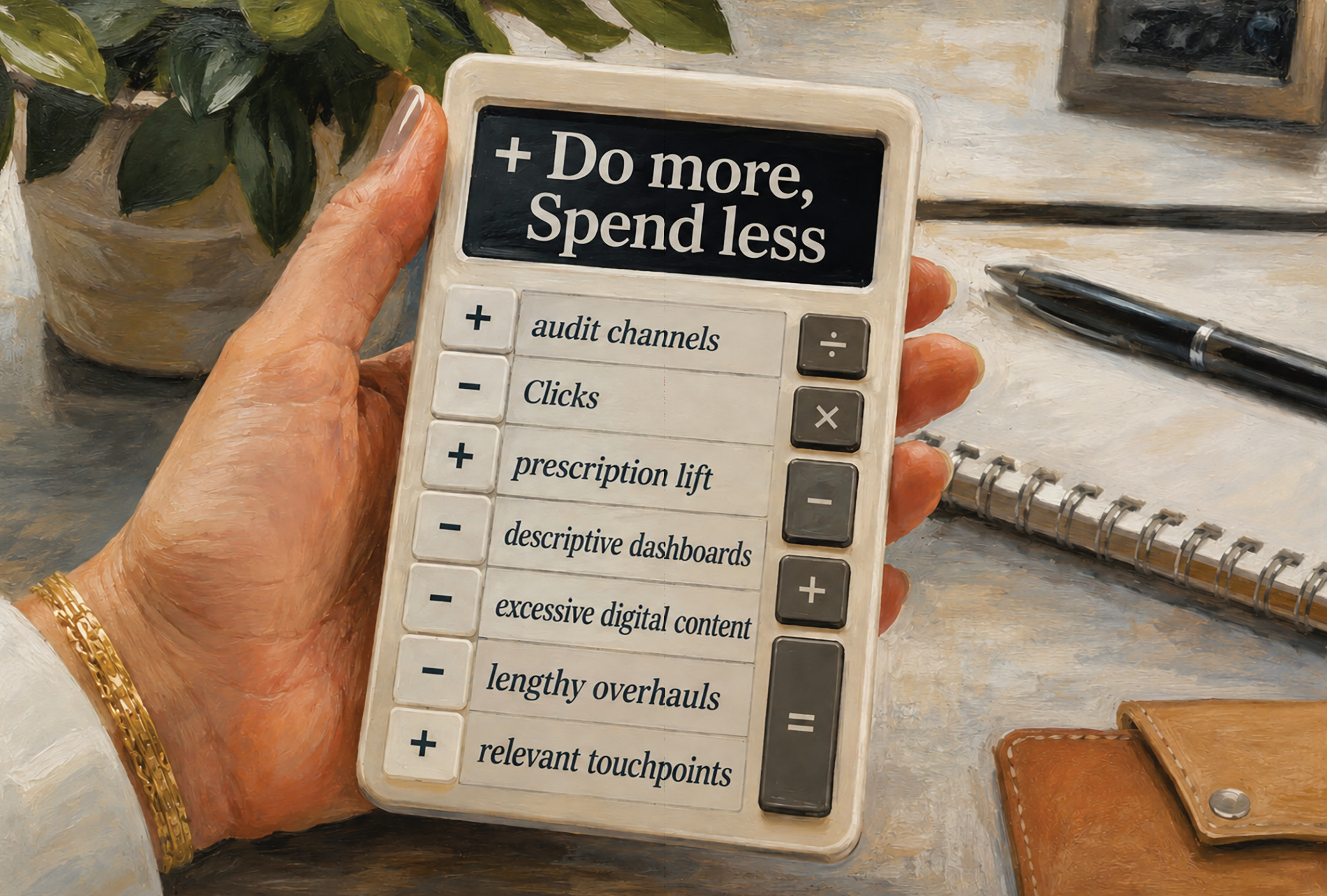
The New Era of Adaptive Pharma Marketing
We spend millions on digital saturation that barely resonates with physicians, all while field teams lack visibility into HCP priorities and activities. This expensive misalignment is inefficient, and it erodes both brand trust and audience activation. You launch a sophisticated digital campaign, but it lands with a thud. You’ve mapped patient journeys, secured medical and regulatory approvals, and spent heavily, but reaching doctors is harder than ever. The solution isn’t to add more channels or “do more with less.” In fact, it’s focus that matters, and we need to subtract the channels that don’t ultimately drive prescriptions.
The wall between brand marketing and field sales is a liability, and it’s driving physicians away. As one brand marketer recently said, “There’s nothing worse than an automated CRM message going out in the morning, then a sales rep seeing the HCP that afternoon with no visibility, delivering two completely different messages.”
Flooding digital channels with ads doesn’t fix our challenges, especially if reps can’t see what is being shared or how HCPs engage with it. Only 1 in 3 doctors find pharma’s digital content useful, even as the volume of content skyrockets. At the same time, physicians are becoming highly efficient, digital-first information seekers—nearly three in five now use AI for clinical decision support. If a brand’s digital media and field representatives deliver disjointed or conflicting information, the HCP will simply tune the brand out.
The Coordination Gap Where Omnichannel Falters
We all pushed for omnichannel to create a seamless experience with the best of intentions. But we still have siloed teams, over-stretched strategies, and spray-and-pray media buying.
Survey data from 151 biopharma executives this year shows the execution gap. 62% report that organizational silos still limit visibility between field and marketing, so reps walk into the clinic without the whole picture for that HCP. 61% struggle with data spread across fragmented, noncommunicating systems–meaning we have the data and probably paid a lot to get it, but we can’t activate it effectively. And 52% use tools that don’t support cross-team coordination, effectively guaranteeing a disjointed experience for customers.
This friction stalls commercial momentum. Executives report inconsistent, confusing experiences for HCPs (43%) and missed opportunities to drive impact and revenue at critical moments like launch (41%).
Marketers cannot optimize what they cannot measure. Over half (51%) of surveyed executives say they cannot easily attribute campaign ROI because specific digital engagements are not tracked, and 50% are paralyzed by decision-making data that is fragmented across disparate systems. True, impactful engagement—that right HCP, right channel, right moment, right message ideal—remains impossible when digital campaigns and field CRMs live in separate worlds.
Building Shared Commercial Intelligence
This disconnect hurts everyone. Sales reps struggle (52% say they lack visibility into marketing), and marketers miss out on real-world clinical feedback.
Marketing and sales teams know what they need from each other, but they simply lack the shared infrastructure to exchange it. When asked what insights would be most valuable:
Field reps want targeting guidance on which HCPs to prioritize (53%) and visibility into their HCPs’ digital behaviors (46%).
Marketing teams require real-world clinical feedback, with 52% seeking immediate updates on prescribing shifts and 40% needing to know how HCPs react to recent campaigns in the clinic.
To solve this, the industry must transition to adaptive optichannel orchestration, where every touchpoint is dictated by real-time relevance.
“Over half (51%) of surveyed executives say they cannot easily attribute campaign ROI because specific digital engagements are not tracked, and 50% are paralyzed by decisionmaking data that is fragmented across disparate systems.”
Optichannel isn’t the next buzzword. While omnichannel is about connection to be linked everywhere, we think about optichannel as subtraction. Engaging on the optimal channels for your audience means using data to know where not to be, saving budget and rep hours on low-impact activities. It’s optimizing for efficiency for your organization and relevance for your customers.
An Adaptive Scenario in Action
If a specific oncologist historically ignores digital advertisements but values face-to-face scientific exchanges, an adaptive system automatically suppresses digital ad spend for that doctor. Instead, it routes a contextualized alert to the field rep. Conversely, if a physician is “no-see,” the system automatically shifts budget into programmatic or point-of-care ads to bridge the coverage gap.
1. Look for Actionable AI, Not Static Dashboards
It’s time for us to start building intelligence that can act rapidly. 60% of leaders want speed and precision, and we need systems that turn live data—like a new lab result—into an automated action within 24-48 hours. Agentic AI applications can now act within complex industry constraints and ingest then act on data, sending alerts directly into the rep’s CRM or pushing a data-driven decision plus action into a digital marketing engine.
2. Tie Performance to Prescriptions, Not Clicks
Dashboard fatigue is real. According to the survey data, 60% of executives say “speed of execution” and 59% say “precision of targeting” are the most critical factors for campaign success today. Yet, the industry has spent millions on descriptive dashboards that simply generate more charts or build static, outdated target lists.
Measuring marketing on clicks or audience quality scores and sales on reach and call activities keeps teams in silos. Align both on a single metric: actual prescription lift. Build an integrated attribution model that tracks how a combination of digital exposure and field visits drives clinical decisions. Pulling different data sources together into one system is now achievable.
3. Focus on Agility
Technology must support market realities. When asked what solutions would make the biggest difference in their ability to coordinate, 46% of executives pointed to direct integration within their existing CRM or sales tools, followed closely by better analytics and reporting (42%).
With shrinking launch windows and increasing fragmentation, brand teams cannot afford 12-to-18-month overhauls. New solutions should sit atop existing CRM plumbing, providing a lightweight orchestration layer that lets reps see what an HCP engaged with in the last 48 hours, regardless of the system.
Precision Is Your Competitive Edge
Pharma marketing must evolve, and precision-based coordination is critical now that the “more is better” era is over. By triggering coordinated actions across digital and field workflows, you ensure relevance. When we build orchestration discipline and measure our combined impact through clinical outcomes, we deploy campaigns faster, prove our value definitively, and ensure every dollar drives meaningful results. Start by ensuring every single touchpoint is relevant or don’t make it. Audit your channels, push to see lift impacts quickly from partners, and break down those field-marketing silos so your team will know exactly what to stop doing to deepen impact.