 US Pharma Marketing

On September 29, 2025, we gathered our 2025 Trailblazer Brand Champions for a roundtable discussion sponsored by Accenture Song Life, centered mainly around how AI is reshaping HCP and patient interactions, influencing brand trust, content accuracy, decision-making, and problem-solving, while highlighting the need for careful oversight, audience testing, and strategic adaptation across commercial, patient, and digital channels. The discussion included the participants listed and moderated by Alanna Peet of Accenture Song Life.
ALANNA PEET MODERATOR
Accenture Commercial Consulting, Managing
Director
Accenture Song Life
ROBERT HILLMAN
US Head of Marketing, Immunology
AstraZeneca*
DAVID GUIGA
Head of Commercial Innovation
AstraZeneca*
SHAWN BOOTH
Sr. Director
AstraZeneca*
CHEYENNE STEWARD
Senior Associate Director, HCP Marketing
Boehringer-Ingelheim*
STACIE PATTERSON
Marketing Director, GSK*
SHERIF ESMAIL
Director Marketing/Neurology HCP Marketing
Lundbeck
DEIDRE-ANN PERRY
VP, Business Unit Head, Neurology
Lundbeck
SAM GRIGGS
Executive Director, Marketing Strategy
Novartis*
JASON WILLIAMS,
Operational Excellence, Program Mgt.,
Breast & Women’s Health MST, Novartis*
KATIE DONNINI
Senior Director, Patient Advocacy
& Stakeholder Management, Otsuka*
DAVID ZILK
Global Decision Science Lead, AI-driven
Customer Engagement, Sanofi*
KEN BEGASSE
Managing Director
Accenture Song Life
ENSLOW KABLE
Managing Director, Accenture Song Life*
CHRIS PULLON
Managing Director, Accenture Song Life
ALEX KOOLURIS
Enterprise Account & Solutions Leader
Accenture Song Life*
PM360 thanks Accenture Song Life for sponsoring the Trailblazer Brand Champion Circle of Excellence
Alanna Peet: When you hear AI in marketing, what comes to mind first? Is it the tools, the opportunities that might come, the risks?
Sam Griggs: We have such an insane amount of data in the pharma industry, even just within marketing. And sometimes we do a good job of using it, but a lot of it just sits in places where we’re not able to use it. AI creates a huge opportunity to be able to assess and understand that data much quicker. A standard practice now is to put all of our customer insights into agents, which I’m sure most people do. You can prompt them, ask questions without having to go back out to the field. And you don’t have to ask your research agency if they can find something. AI can find those answers for you.
David Guiga: I initially approached this with a technology‑first mindset—let’s put an agent into the process and see how it impacts speed, quality, and outcomes. But I quickly realized it’s really about people and process. You can get the technology exactly right, but if you don’t bring those other two along, it’s going to fail.
Jason Williams: When a lot of people think about AI, they think “what can it do for me?” What we’ve learned along the way was that the question is not what it can do for us, but how it can augment/improve what we’re already doing. We don’t look at it as a tool, we look at it as a partnership.
David Zilk: To give an example when it comes to process changes and how agency models are evolving, our team has done this in the area of content creation. We piloted bringing large parts of the content creation process in-house and closer to the marketing team, with AI embedded directly into those workflows. That allowed us to significantly reduce the cost and friction around content creation and move much faster in terms of iterations and versions. More broadly, this doesn’t mean agencies go away, but it does mean they have to adapt how they create value. The role shifts beyond content generation toward areas like strategy, creative direction, media execution, and moments where human judgment and experience really matter.
Alanna Peet: Have you seen an impact on customer engagement with AI content that’s gone to market? Can the customer tell the difference between AI-generated content and content created going through an agency? Is it getting the same results? Can AI replace what agencies are doing creatively?
…“What can [AI] do for me?” What we’ve learned along the way was that the question is not what it can do for us, but how it can augment/improve what we’re already doing.”
David Zilk: The right message, the right customer, the right moment—all of these pieces still have to come together. One real change AI enables is that when content creation costs come down, teams can create many more iterations and versions much faster. That creates the conditions for more advanced next best action approaches, because decisions can be updated continuously instead of being locked in early. Where many organizations are still limited is that engagement or sales data alone doesn’t truly tell you who an HCP is. It doesn’t explain what matters to them, how they make decisions, or what actually influences their behavior. That requires going beyond surface level metrics and bringing in broader behavioral signals that reflect preferences, context, and real world decision patterns. AI helps by integrating all those signals and translating them into more relevant decisions. From the customer perspective, what matters isn’t how content was created — it’s whether it reflects their reality and supports better decisions.
Enslow Kable: A big flag in this is the privacy component. Thinking about the patients and making sure they’re still being protected through HIPAA. We certainly know a lot about the people we’re targeting and trying to message, but there does need to continue to be that setback where you have privacy standards in place. That’s a big topic with our compliance team.
Alanna Peet: How are you guys seeing your organizations upskill and train people to be able to think about things differently? What have some successes and challenges been?
Shawn Booth: Our company does a really good job of making the tools available; the training is there. The problem comes down to the individual community. I’ve got some people that are 100% trying to be better, learn things, and try different tools. Not all the tools are the same—sometimes one works better for the task at hand. But I have a couple people who [are not adapting]. Within five years, they may be in a different situation than the people who are really trying to internalize it.
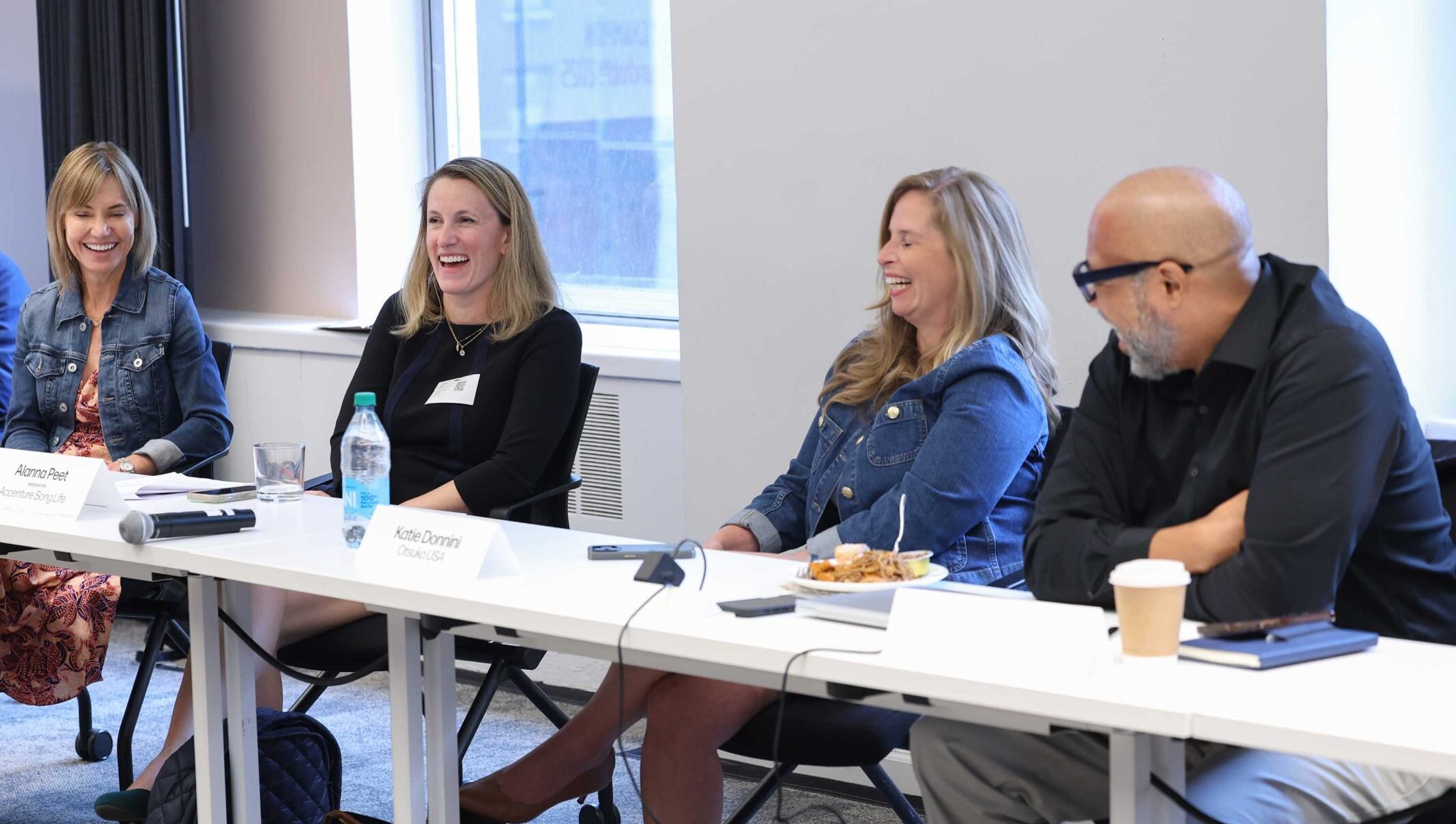
“PM360’s Brand Champions share a laugh with Accenture Song Life’s Moderator, Alanna Peet, at the 2025 COE roundtable.”
Jason Williams: We’re generating a governance board, to show everything from the top level. There are also massive amounts of communication, bi-weekly training, forums, etc. I was writing agents two years ago before Novartis was even thinking about it. I was using some of these agents at work to the point where some people had to come and ask questions on how the content was being generated. Some people also told me to slow down because I was moving too fast. I was using agents for medical boards, for commercial marketing, and patient experience. Novartis had to pull me back a bit because they weren’t necessarily ready for all the stuff that was being built; not just for me, but for others as well. I formed a sort of radical group within the organization, we were building multiple tools. My response to being told to slow down was to tell them to speed up. You have to let upper management know what you’re doing, how fast you’re doing it, so they can too.
“One real change AI enables is that when content creation costs come down, teams can create many more iterations and versions much faster. ”
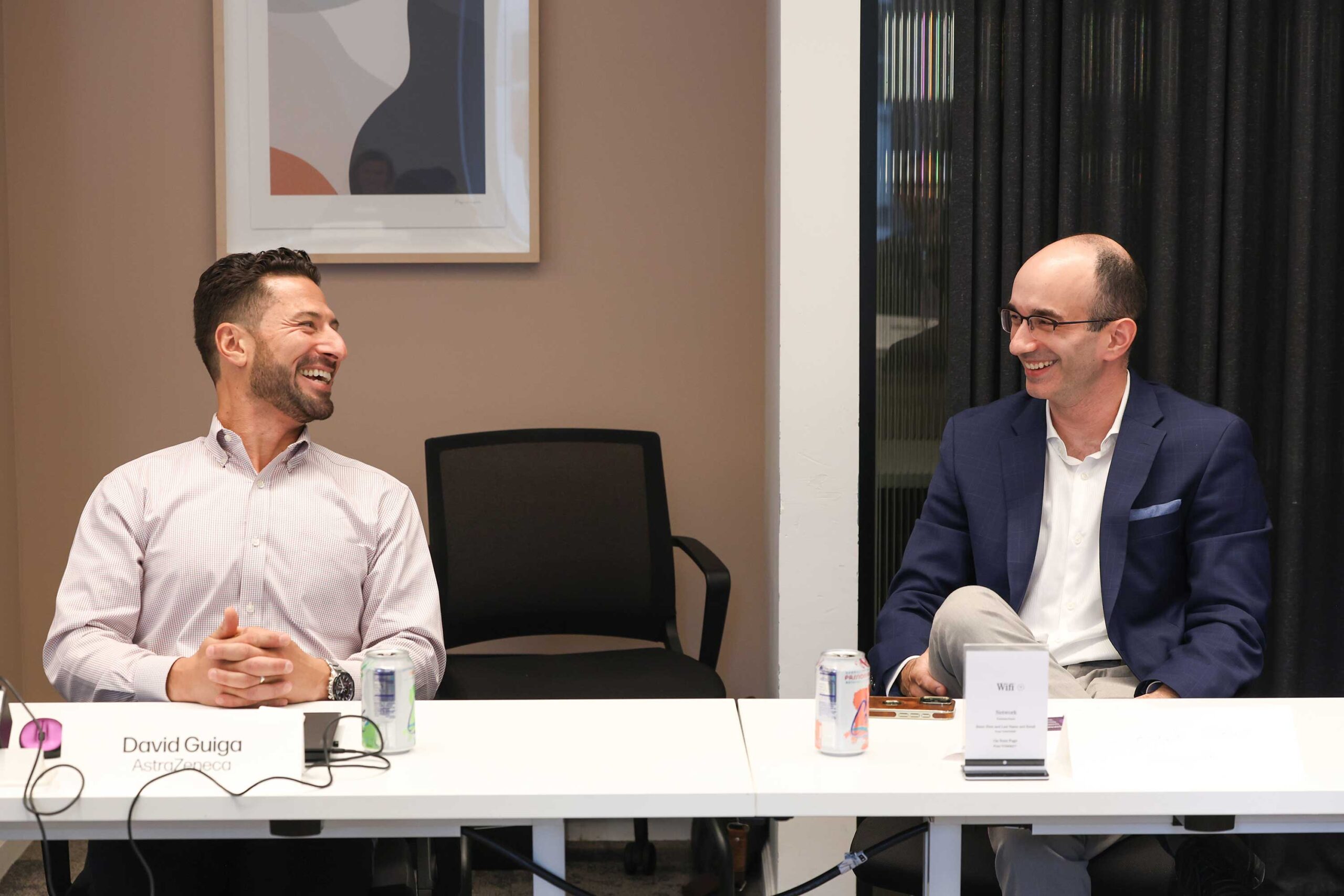
David Guiga and Joseph Sklar, PhD were unquestionably upbeat during the roundtable discussion about AI innovations in Healthcare.
Alanna Peet: How do you feed sales data into the machine so you’re getting insights from people who are having those direct interactions? Have you started to see that in your organizations, and how do you think about the sales rep in the mix?
Robert Hillman: We pull real field insight straight into our models by capturing a few simple answers to questions after key interactions—what content was used, what resonated, critical questions asked, and requests for next steps. That data sits alongside channel and content performance, so the next-best-action engine learns quickly and tailors recommendations by specialty, setting, and preference. The rep remains right at the center in combination with all other generated insights to support customized education.
David Zilk: It really depends on the brand context. In a rare disease setting, the key challenge might be identifying when a very small number of patients appear, so timing becomes critical. In a more competitive category like diabetes, the question is less about timing and more about how to influence choice and differentiation across many interactions. The mindset changes by brand, but the fundamentals stay the same. You feed AI the data that truly matters—sales interactions or engagement signals, but also data that helps describe who an HCP is, what matters to them, how they make decisions, and how they operate in the real world—and let it synthesize those signals to support the most relevant action, whether that’s messaging, patient identification, or timing. The mechanism is consistent even if the use case isn’t.
Stacie Patterson: I started as a sales rep. Messaging then was a lot less nuanced than it is today. Now we’ve got dynamic routing, data, predictive analytics. It’s really going to help as far as showing up and what messages to use when you’re there. The ones who are adopting it are doing very well with that and following that yellow brick road to get where they need to.
Sam Griggs: If you explain this as: “This enhances you; you’re much more likely to hit your goals with this,” it shows how it helps them to be better, and empowers them to do their job better without it feeling like it’s dictating “say this next, go here next”…turning them into deskilled employees. It’s got to make them feel sharper, stronger, better versions of their professional selves rather than dumbing them down and making them like the human face where an AI just tells them what to say. And I think so much of that is about how we communicate it, how we build it, and how we think about that human experience.
Cheyenne Steward: It’s about transparency, right? Making sure that everything is being displayed to the sales floor, showing that there are resources and tools available. Show them what’s in it for them, because there’s a lot in it for the sales force. You also have to let them have autonomy, knowing that there are some gray areas there too.
Alanna Peet: This also speaks to the importance of the relationship with HCPs. If patients don’t know who to trust, hopefully they’ll go back to their doctors and expect them to give them the right information. So how do you continue building and maintaining that relationship with HCPs in a trusted way, so they can remain that source of truth patients rely on?
Shawn Booth: If consumers start to feel like they’re being tricked in any way, doctors are going to become even more valuable to them in terms of that treatment decision. I don’t trust what I read sometimes versus information I get actually speaking to somebody I’ve got a relationship with.
Katie Donnini: When it comes to patients, often they want to hear from other patients. So, if there’s a chatbot involved, it’s different than when you actually experience something or hear it from someone else (who has lived experience). As to Shawn’s point on mental health and how patients are going to feel tricked, I think that’s especially going to matter when they’re seeking support from a pharmaceutical company website. We have to focus on how much we’re using AI directly interfacing with our customers. Maybe there are some things we can utilize AI for that won’t impact the overall customer experience, in a negative way, on the patient and physician side that still gives the human element people crave when making major life decisions.
Stacie Patterson: We have to just be rigorous about testing with our audience—just seeing how they respond. They may shift over time but we just have to keep testing.
Robert Hillman: Our approach is to use AI to surface clear, evidencebased content and encourage a shared decision making model when information surfaces across AI databases that helps clinicians have better conversations with their patients. We encourage patients to bring questions back to their doctors, and we equip HCPs with emerging patient tools that clarify options, highlight safety and efficacy data. AI can be helpful, but it’s only as reliable as the data behind it, so we keep the clinician at the center as the source of truth and use technology to support, not substitute, their judgment.
Clockwise from left: David Zilk, Alanna Peet, Sam Griggs, and Shawn Booth.
“We encourage patients to bring questions back to their doctors, and we equip HCPs with emerging patient tools…”
Katie Donnini: I tried this with one of our clinical trials. The questions it was spitting out were great and it made me hopeful that patients are going to get what they need quicker. It also made me question then, are the resources that we create going to be necessary? Or are we going to have to rethink the sort of resources that we provide from a consumer perspective?
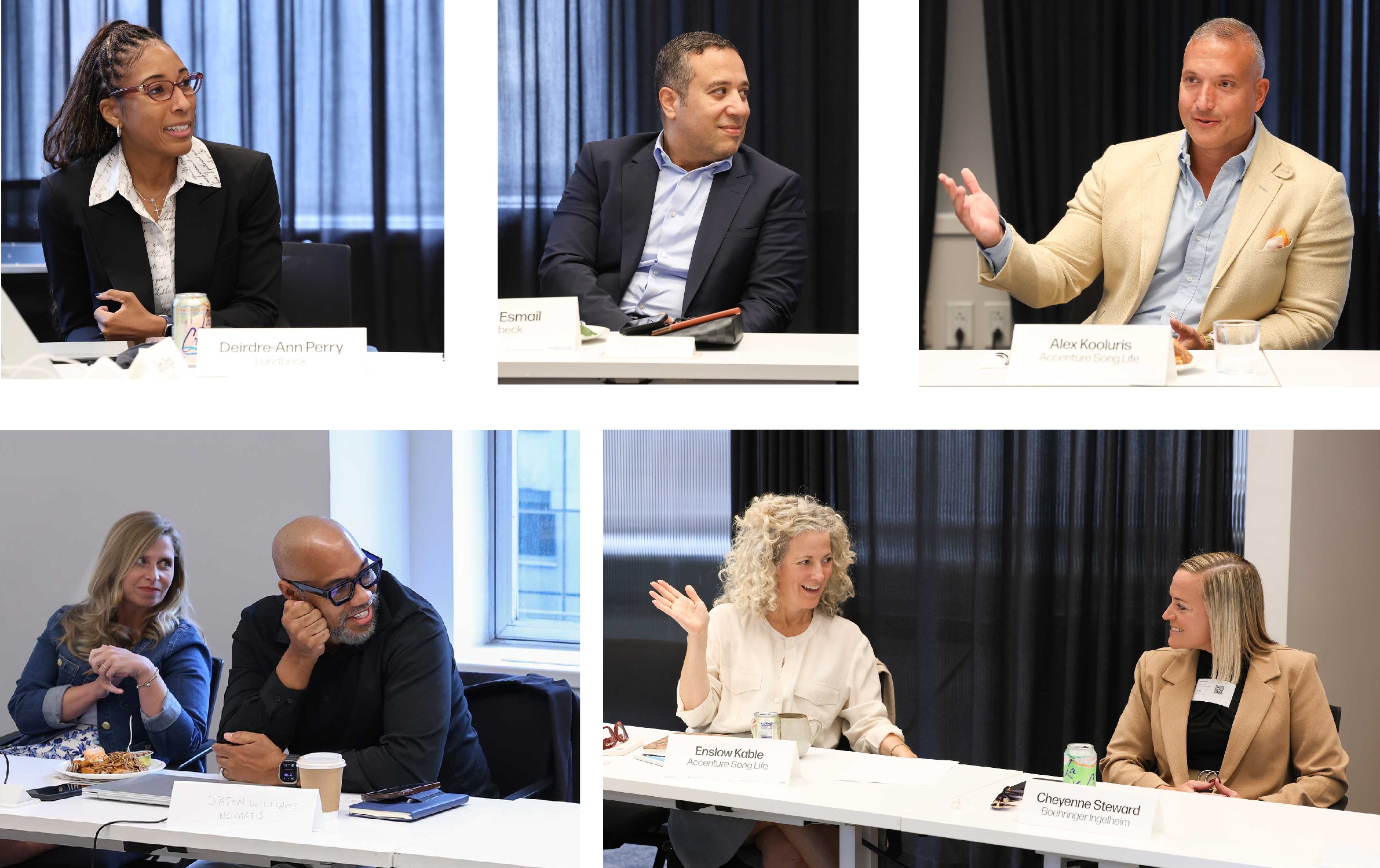
Clockwise from top left: Deidre-Ann Perry, Sherif Esmail, Alex Kooluris, Cheyenne Steward, Enslow Kable, Jason William, and Katie Donnini.”
Alanna Peet: How do you make sure the input AI is using is pulling the right data from your brand to generate the answers you want? And how do you help train that process?
Alex Kooluris: This speaks to the importance of how your brand is showing up in social and other platforms like Reddit, things that traditionally you never would probably navigate to without ChatGPT. We’re truly at a state where you don’t own your brand anymore, but you need to make sure that you have active participation in those things. You can’t not comment and let them fester.
Jason Williams: We’ve had instances where a statement came from an HCP that had some of the records they were looking up from ChatGPT that were incorrect. So we looked it up internally. It was correct in our internal database, but we confirmed that it was incorrect externally. This was such a frustrating process because I don’t even think OpenAI is ready. We have this whole department that’s responsible for making sure the information is correct.
David Zilk: The biggest mistake is thinking training AI is mainly a technical exercise. In reality, it starts with being very clear about what decisions you’re trying to improve. The inputs have to be intentional. Not all data is equally valuable, and more data doesn’t automatically mean better outcomes. You need to prioritize signals that reflect real behavior and real outcomes, and continuously validate whether the recommendations AI produces actually lead to better decisions. Humans stay in the loop by setting objectives, reviewing outputs, and adjusting the system when reality changes. AI doesn’t replace judgment—it scales it, as long as the inputs and the feedback loop are designed thoughtfully.
The opinions expressed in this article are the participants’ own and do not necessarily reflect those of their affiliated companies or organizations.