US Pharma Marketing
Populus Article June 2026
Virtual Care in America: The Populus Report
How Patients, Providers, and Marketers Are Redefining Care Through the Screen
Gabriela L. Laracca | graphics from Populus
Telemedicine… telehealth… virtual care… all these phrases have described the moment when a patient and HCP connect through a screen. Virtual Care, by definition, encompasses every digital channel through which a patient and an HCP exchange clinical attention—SMS messaging, patient-portal messaging, and more. The vocabulary surrounding it has been contested because the category has been fragmented. Each tactic has lived under its own banner and has been measured by its own metrics. The result is a media environment the industry invests in but does not yet describe with a single voice.
The Health Resources and Services Administration (HRSA) defines telehealth as “the use of electronic information and telecommunication technologies to support long-distance clinical health care, patient and professional health-related education, health administration, and public health.” In the HRSA framework, virtual care is the subset—“the clinical care portion (e.g., virtual visits, therapy sessions, follow ups) delivered through telehealth technologies.” Telehealth is the umbrella, and virtual care lives inside it.
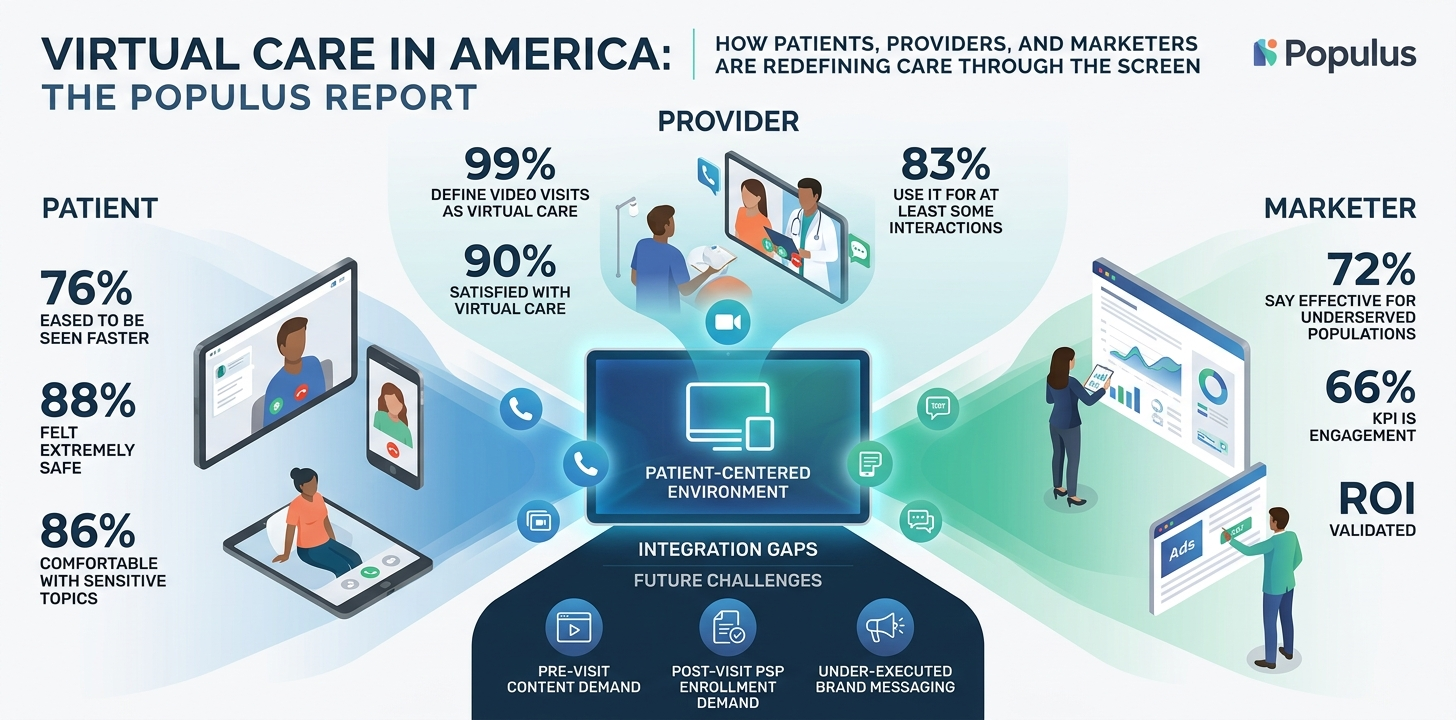
Virtual Care is the ecosystem all these communication tactics share—the unified, patient-centered environment that makes their connection coherent. A new definition has been proposed, and it is not a redefinition, rather, a proper naming of what the patient, the HCP, and the pharma buyer already operate as a single environment. Collapsing every digital patient-HCP touchpoint under a single category does four things the fractured definition cannot. It produces an integrated ecosystem instead of a portfolio of opportunistic placements. It future-proofs the category against new modalities that will inevitably emerge. It gives brand teams one strategic conversation in place of a half-dozen tactical ones. And it gives the measurement conversation a perimeter—which is the precondition for the attribution and ROI standards the category is still building.
The new definition: Virtual Care is the category of all digital environments—video, phone, text, email, patient portal, etc.—where a patient and a healthcare provider exchange clinical attention. Telehealth is one tactic within it. Every patient-HCP digital touchpoint, before, during, and after the clinical moment, lives under this single header.
This is the definition “Virtual Care in America: The Populus Report”—which we will explore in this article— is built on, and the only definition that lets brands operate in this category the way the patients and providers inside it already do. Populus Health Technologies, a Princeton-based virtual care company, partnered with DHC Group, PM360, and Researchscape to examine the impact of virtual care on patient outcomes in the US through the perspectives of patients, HCPs, and pharma marketers. The findings, published in the listed report, include survey data from more than 1,250 respondents across all three groups.
Although each stakeholder group offered important perspectives on the topic, patients were the driving force behind virtual care’s evolution. What began as a necessity during COVID-19 quickly became a preferred option due to its convenience, leading patients to seek even greater access and functionality. Providers met them there; clinicians who once treated virtual care as a concession to the pandemic now practice it routinely. Pharma marketers have arrived with investment, belief, and early proof. Budgets are up and ROI is validated. The category question has closed, but the execution conversation is still—too often—a conversation about tactics.
What the data in this report shows, across all three perspectives, is that virtual care is not a media environment—it is a human one. Every screen is a person at a moment in their health. Every appointment is a clinician choosing how to be present. Every message that reaches a patient inside a virtual care experience is not a touchpoint in a funnel—but an encounter, a small human moment, asked to do meaningful work.
Integration is the only pathway forward. Not integration of platforms or data pipes—though those matter—but integration of moments: the pre-visit window where a patient is already on screen, focused and asking questions; the visit itself, where clinical trust is built; the post-visit hours, where support programs and education either reach the patient or don’t. These are the places where the three paths converge.
How the three stakeholders define virtual care
Before the findings in this report can be read together, one question must be answered: What do the three stakeholder groups actually consider to be virtual care? See Figure 1.
| Modality | Patients | Providers | Pharma marketers | Spread |
| A video visit | 80% | 99% | 79% | 20 pts |
| A phone visit | 60% | 87% | 71% | 27 pts |
| Patient portal messaging | 43% | 50% | 63% | 20 pts |
| Text / SMS messaging | 38% | 27% | 60% | 33 pts |
| Email correspondence | 30% | 30% | 60% | 30 pts |
Figure 1
Providers hold the narrowest definition. Video and phone are unambiguously inside the category (99% and 87%). Everything else is contested. Providers also say they use patient portal messaging in their delivery of virtual care at 67%, but only 50% consider it to be virtual care—practicing through modalities they do not fully recognize as the category. Patients hold a broader but uneven definition, with video (80%) at its core, then phone (60%), portals (43%), SMS (38%), and email (30%). Pharma marketers hold the broadest and most uniform definition. Every modality is considered virtual care by a clear majority, with only 19 points separating the highest and lowest. For marketers, virtual care is less a specific modality than a media environment encompassing every digital touch between patient and provider.
Only video visit sits unambiguously inside the category for all three stakeholders. Every other modality is contested, and the contests are not small. SMS messaging is considered virtual care by 60% of marketers but only 27% of providers. A marketer launching an SMS adherence program believes they are operating inside virtual care. A majority of the providers whose patients receive that message do not consider SMS to be virtual care at all. The category the industry is measuring, investing in, and building programs around is not ‘one-size-fits-all.’
Speed to Care
Virtual care has become America’s most effective access intervention. Patients who would not have seen a physician are seeing one. Specialists otherwise out of reach are in the room. Rural and underserved populations are better served here than anywhere else in the system. “Speed to care” is a theme where all three stakeholders agree, in their own words, that the category has delivered on its original promise.
For patients, it’s everything. 76% of patients say virtual care makes it easier to be seen faster, while 54% of patients actively chose a virtual care visit over an in-office visit when both were available. Virtual care also makes their lives easier with 45% citing faster availability and 43% citing time saved.
Highly-revealing data in the patient survey was not about what virtual care provides, but about what would happen in its absence. 56% of patients say they would have seen their doctor in person eventually with delay, while 10% said they wouldn’t have gotten treatment at all. Across specialty care, the pattern is consistent and severe: 70% of cardiology patients, 73% of OB/GYN patients, and 78% of neurology patients would have delayed care or skipped it altogether.
Providers are utilizing virtual care to close the gap, with roughly three in four patients in these specialties receiving care they would not otherwise have received. 73% of providers say virtual care decreases treatment delays, and 63% say it offers patients access to specialists not locally available. 83% of providers use virtual care for at least some of their patient interactions; 36% use it for half of their interactions or more.
Pharma Marketers have also recognized it outperforming other channels for reaching patients, with 72% saying it’s more effective than in-person settings for reaching underserved populations. Marketers identify rural HCP reach as one of the clearest use cases where virtual care outperforms traditional channels.
Trusted
Patients, providers, and pharma marketers trust virtual care enough to operate honestly inside it. Patients are not merely comfortable in virtual care—they are comfortable with the most sensitive conversations in medicine. Providers are satisfied with it as part of their practice and practicing confidently inside it, and marketers are investing with conviction.
88% of patients felt extremely safe using virtual care for their healthcare needs, and 86% of patients are extremely comfortable discussing personal or sensitive topics virtually. 87% of men and 88% of women report being completely or very satisfied with their last telehealth visit, with older patients expressing higher satisfaction than younger patients. 76% say it’s easier to use than expected.
90% of providers are also satisfied with virtual care, and 47% were very or completely satisfied. 50% of providers are also completely confident with virtual diagnosis. From a pharma marketer perspective, 48% say virtual care has led to much better attribution than other digital media channels.
Trust compounds. A patient who feels safe discussing sensitive topics becomes a patient who engages fully with their provider. A provider who is confident in virtual diagnosis becomes one who expands the use cases. A marketer who sees superior attribution becomes one who invests further. The most intimate conversations in medicine are happening through screens, and patients are not just tolerating them—they are choosing them. Any framing of virtual care as a lesser or secondary channel is contradicted by the level of trust patients have already placed in it.
Integrated Impact
Every stakeholder in this report is pointing at a gap. Patients want content and support during the pre- and post-visit windows. Providers want workflow continuity and specialist reach across the care journey. Marketers report that their most effective channel pairings are the ones that connect virtual care to the human moments around it—patient support programs, SMS messaging, EHR messaging. The integration problem in virtual care is not a data pipe problem or a platform problem—it is a moment problem. The category has built the environments. What it has not yet built is the orchestration across the moments where the three paths actually meet.
73% of patients would find the option to enroll in patient support programs extremely or very valuable during or after their virtual visit—the post-visit window. The attentional data above (the pre-visit window) combined with the PSP demand above (the post-visit window) describes a patient asking to be met in two moments the industry has not fully designed for.
Providers admit to an increase in continuity of care through virtual environments. 72% of providers say virtual care improves their workflow; and 93% of providers use virtual care for follow-up visits—the post-visit care continuity is already happening in the virtual environment. 92% of providers use virtual care for prescription management and refills; and 73% of providers use virtual care for chronic care management.
57% of marketers say patient support programs are the channel that pairs best with virtual care; while 55% cite SMS messaging and 51% cite EHR messaging. The tactic mix shows marketers are investing where they believe the integration lives—but patient and provider data suggest the pre-visit and post-visit moments are still underserved relative to demand.
Integration in virtual care is not an abstract ambition. It is a set of identifiable moments—pre-visit, visit, post-visit, follow-up, Rx management—where the three stakeholders are already meeting and where the orchestration is either present or absent. The patient who wants content while waiting, the provider running a prescription refill through telehealth, and the marketer deploying a patient support program after the visit are all operating on the same care journey without yet being connected to one another.
Engagement
Patients inside the virtual care experience are usually more prepared, focused, and receptive to those in physical exam rooms, because the environment is one of their choosing, and within their control. 51% of patients are focused on their screen before and during a virtual care appointment, and 46% of patients would be interested in receiving health information or educational content while waiting for their appointment. Younger audiences show the strongest appetite for patient education and health content inside the virtual care experience. 82% of providers cite no-show reductions as a benefit of virtual care, and they report a 66% appointment attendance gain.
For pharma marketers, engagement has also become the category’s defining KPI for a reason. Engagement is the #1 KPI pharma marketers use to evaluate virtual care effectiveness—cited by 66%, ahead of new patient starts (56%), script lift (50%), and reach (48%). 70% of marketers also believe virtual care is very or extremely effective in supporting patient education.
All three perspectives show that in the virtual care environment, those inside it are more present than those in the traditional care system. And the presence extends beyond the appointment itself. The pre-visit window, a moment of captive, digital, pre-clinical attention—is new real estate in American medicine, created by the structure of the virtual visit.
Differing Expectations and Outcomes
The most important finding in this report is also one hidden in plain sight: all three stakeholders are producing outcomes, and none of them are using the same words to describe what they’re producing. Patients describe quality outcomes as satisfaction and safety. Providers describe outcomes as adherence, follow-up, and chronic care management. Marketers describe outcomes as script lift, new patient starts, and ROI. Three vocabularies and one underlying phenomenon. The category has graduated into quality outcomes territory—the data supports that claim on every axis—but the industry does not yet share the language to describe what that graduation means.
Patients are actively demanding programs, content, and support from within their virtual care experience, however they’re opening the door wider than the industry is walking through. Patient demand for pharma-adjacent support inside virtual care consistently exceeds the current delivery of that support. The pre-visit attentional window and the post-visit PSP demand both represent patient invitations the industry has not yet answered at scale.
Providers are also being more tolerant of pharma messaging in clinical settings, when they’ve historically been less tolerant in comparable settings. More than half of providers surveyed (53%) find pharma presence in virtual care acceptable or helpful. Yet, 57% of providers rarely or never encounter pharma brand messaging in virtual care settings—the category is under-present in the environments where a majority of providers are open to it.
This is where we can recognize that pharma has the budget and the belief, but lacks full execution against the mandate. 81% of marketers increased their virtual care investment in the past year. 69% are using patient portals; 63% are using digital health apps; 59% are using banner ads during virtual care visits. So, tactic adoption is rising, but the gap between what providers accept and patients want, versus what marketers are currently executing, remains wide. Patients are asking, clearly and at volume. A majority of providers are open to the industry answering. Marketers are investing with belief. The invitation is in the room, yet the response has only been partial.
Virtual Engagement. Real Outcomes.
Virtual care’s next chapter will be won not by the companies with the widest reach or loudest presence, but by those who can translate virtual engagement into real outcomes, at the human moments where the three paths meet. Virtual care has outgrown the original vocabulary surrounding it. The word “engagement” is doing too much work. The word “outcomes” is doing too little. The word “quality” has not yet been claimed. The measurement conversation will keep stalling until the industry shares a language for what it is already producing. This is why Populus, in partnership with DHC Group, will publish the Virtual Care Lexicon later this year—the first shared reference for how patients, providers, and pharma marketers describe virtual care. Not a glossary. A translation. Built to close the vocabulary gap this data has now made visible.
The gap between patient demand, provider openness, and current pharma execution is the most actionable finding in this report. A majority of providers are open to pharma presence in virtual care, and patients are actively asking for support inside the experience—the industry’s execution footprint has not yet fully met either signal. Virtual care has become more than a channel. It has become an environment in which the three most important stakeholders in healthcare (patients, providers, and pharma marketers) are finally in the same room at the same time. The question is no longer whether to show up. The question is what to do when everyone is already there.
The answer, the data in this report suggests, is to stop treating this space as a tactical surface and start treating it as what it actually is: a series of human moments, compounded over time, that produce the real outcomes the category has always promised and is already delivering. Virtual engagement. Real outcomes. The category’s next chapter starts there.
References
Andrew Schulman and Edith Hodkinson (Populus Health Technologies)
Mark Bard and Christine Franklin (The DHC Group)
Jeffrey Henning (ResearchScape)