 US Pharma Marketing
The story of Daily Command is not a product story. It is a story about what happens when an industry decides, at scale, that the way it has been working is no longer defensible.
By Harshit Jain, MD — Founder & Global CEO, Doceree
By the time this piece reaches you, the industry will have spent a week processing the news that 75 of the most senior operators in pharma marketing co-built an AI platform called Daily Command and unveiled it last Tuesday in New York. The trade press has covered the launch. Agency leaders have circulated the cohort list internally. Investors have asked the obvious question about market size. What none of that coverage has yet addressed is the question I want to take up here: not what Daily Command is, but why an industry agreed, in public and at the most senior level, to co-build it.
Eight years ago, I left medicine to start a company built around a single question: why does a physician prescribe what they prescribe?
I did not start Doceree because I wanted to build software. I started it because, after years of watching brilliant physicians make prescribing decisions inside a black box and brilliant marketers try to influence those decisions without seeing inside it, I had concluded that the most important unanswered question in commercial medicine was being routed around — by the entire pharmaceutical industry — every single day.
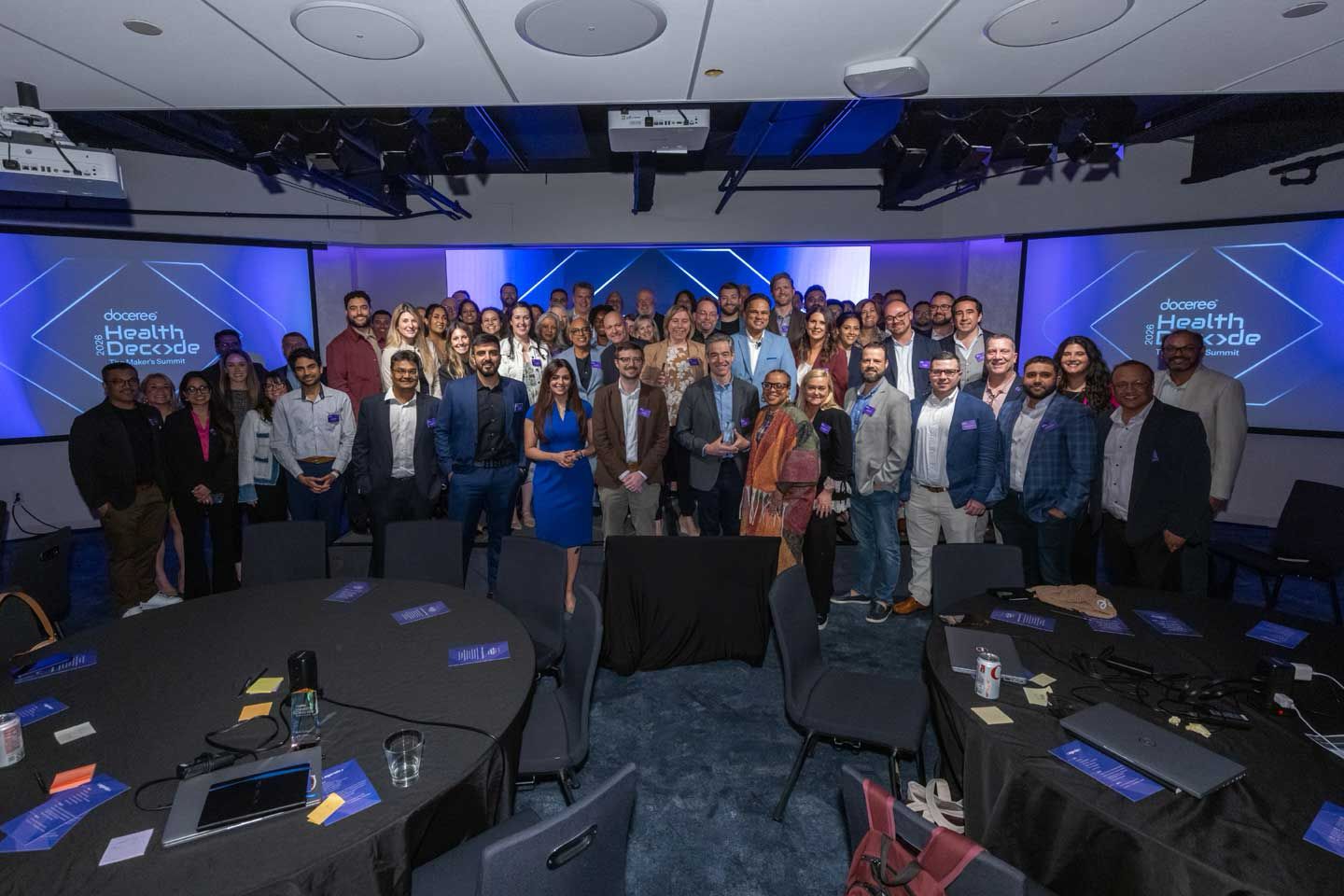
Eight years and four product phases later, on May 7 in New York, 75 of the most senior operators in pharma marketing helped me unveil the answer. The platform is called Daily Command. The story I want to tell here is not about the platform. It is about the 75 people who built it with us, and what their willingness to do that says about where pharma marketing is going.
The problem the industry has been working around
The pharmaceutical brand team is the most strategically important and most poorly equipped function in life sciences. A VP of Marketing running a $2 billion brand opens, on an average Monday, somewhere between 9 and 14 separate systems to do the basic work of running the brand. A market-research portal. An HCP targeting tool. A media-planning platform. A measurement dashboard. A CRM. A medical-legal-regulatory workflow. A competitive-intelligence subscription. An agency project tracker. And underneath all of it, a stack of Excel files exported from each, reconciled by hand, often by a senior person whose time is worth more than the reconciliation.

Strategy lives in one tool. Performance lives in another. The answer to what should we do today? lives in none of them.
The industry has known this for two decades. It has not been fixed for two decades because the fix was not technically possible. Three foundations had to exist first: a clinical-intent data layer that captures prescribing-decision signals at the point of care, agentic AI capable of running brand-team workflows end to end, and pharma-grade governance built into the substrate of the platform rather than bolted on. None of the three existed five years ago.
Doceree spent years building them. Daily Command is what becomes possible on the other side.
What “AI-native” actually means in this context
I want to be careful with the phrase AI platform, because it has been emptied of meaning by overuse. Roughly forty venture-backed companies currently describe themselves as AI platforms for pharma marketing. The vast majority are workflow tools with a chat interface bolted on. That is not what Daily Command is, and it is not what the 75 Makers spent the past quarter building.
When we describe Daily Command as AI-native, what we mean is structural. The platform’s five modules — business intelligence, research and HCP targeting, campaign and activation, performance and measurement, and strategy and policy — are not workflows that have been augmented with AI features. They are agents. They run brand-team work end to end — segment a market, brief a campaign, draft an MLR submission, reconcile a measurement discrepancy — and hand the operator a decision, not a dashboard. The intelligence is the product, not a layer on top of the product.
This distinction matters because it is the difference between AI that adds friction (one more tool to log into, one more interface to learn) and AI that removes it. The 75 Makers were not interested in building the former. They had enough of those.
Why we did not build it alone
There are two ways to build an AI platform for an industry. The first is to write the spec yourself, train the models, and show the result to customers. The second is to identify the people who run the function the platform is for, and build it with them.
For Daily Command, the second approach was not a preference. It was a requirement.
The reason is structural. Daily Command is not a tool that solves a single workflow. It is the environment in which the entire daily loop of a pharma brand team has to run — see, decide, activate, measure — without breaking. There are no vendors who have built that environment before, because no comparable platform exists in the industry. The only people in the world who know what it has to feel like, in detail, in friction, in failure cases, are the people who currently run that loop across 9 to 14 separate systems and have spent careers compensating for the seams.
So we asked 75 of them.
Who the 75 are, and why they said yes
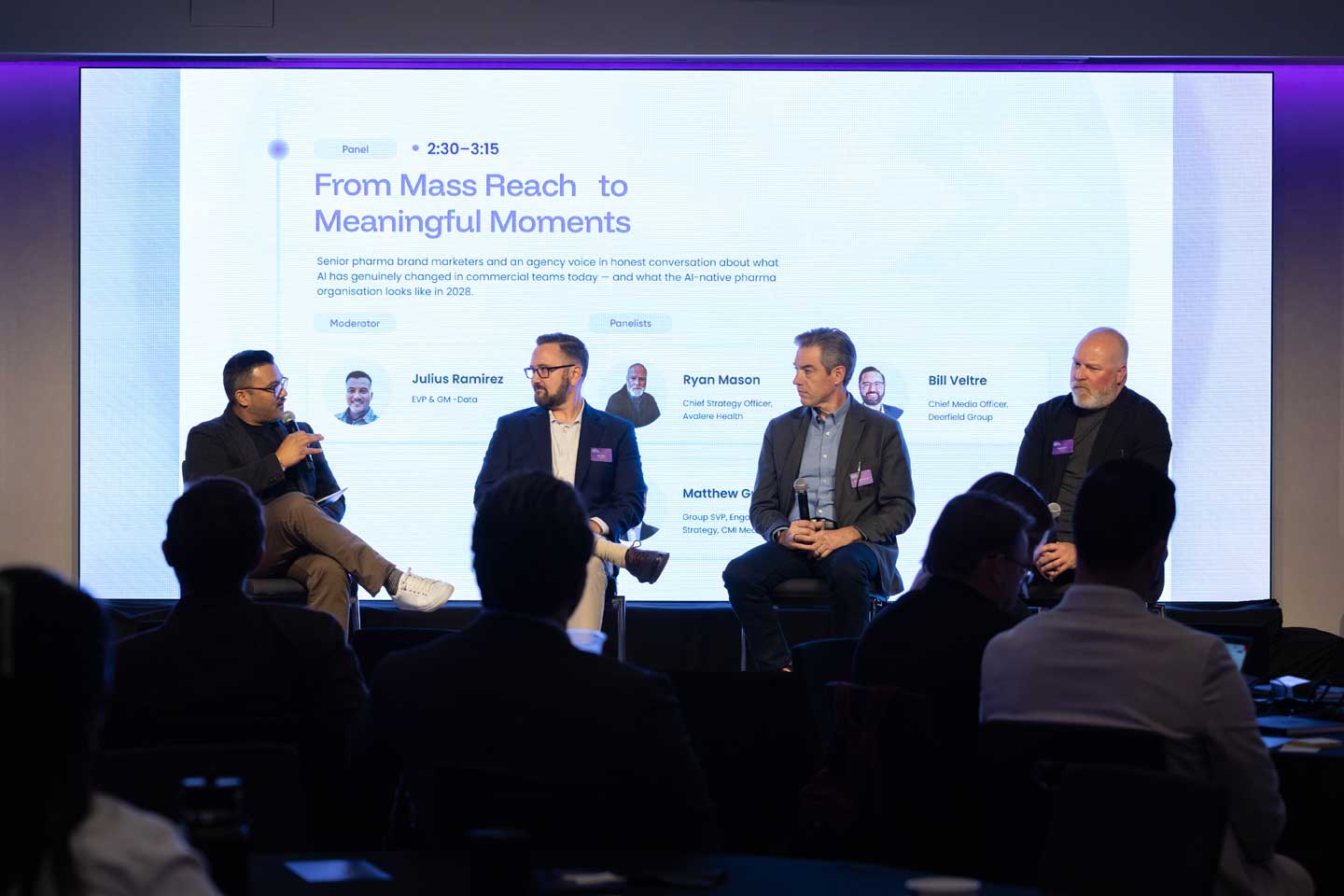
The Makers — that is what we call them — are senior brand, marketing, commercial, medical, and agency leaders drawn from the largest manufacturers and the most influential agencies in the industry. They include leaders from Sanofi, Bristol Myers Squibb, Eli Lilly, Avalere Health, Deerfield, Havas Media, Omnicom Health Group, Real Chemistry, EVERSANA, Ogilvy Health, and others.
Each was selected because they personally run the workflows Daily Command is designed to replace. Over the past quarter, they have contributed module specifications, stress-tested working AI agents in hundreds of hours of sessions, and committed to bringing Daily Command into their organizations.
The reason they said yes is the reason that matters most for what this announcement actually means. They did not say yes because they like our company. They said yes because the cost — to them, to their teams, to the brands they run — of continuing to operate the way the industry has operated for two decades had become indefensible. The hours their teams spend reconciling data across systems are hours those teams are not spending on strategy. The decisions made on yesterday’s data are decisions less likely to be right than decisions made on today’s. The agency briefs written from Excel exports are briefs less likely to produce work that moves a market than briefs written from the same data the agency itself can see.
The 75 Makers are part of the industry that has decided, in public, that this is no longer acceptable.
What this means for agencies
I want to address something directly, because every agency leader reading this will be thinking it.
Daily Command is not an AI platform designed to replace the strategic work agencies do for their pharma clients. It is the surface where that work becomes visible to the brand team and connected to the data the brand team uses to act on it. Agencies that bring their proprietary IP, models, and frameworks into Daily Command — through the open marketplace we are launching alongside the July 14 industry release — make their work more valuable to the client, not less. The agencies inside the Maker cohort understood this before we built the marketplace. It is one of the reasons they said yes.
What happens next
Daily Command was officially unveiled on May 7, 2026, with its 75 Makers publicly named. In June, it enters closed beta with five flagship manufacturers and agency partners, including Avalere Health. The full industry release follows on July 14, alongside the announcement of Daily Command Marketplace launch partners. The list of named Makers, published with their consent, is at doceree.com/health-decode/makers
Eight years ago, I left a hospital ward because a question would not leave me alone. The answer is now in the hands of 75 of the people best qualified to use it. What they do with it next is the part of the story I am most curious to watch.