
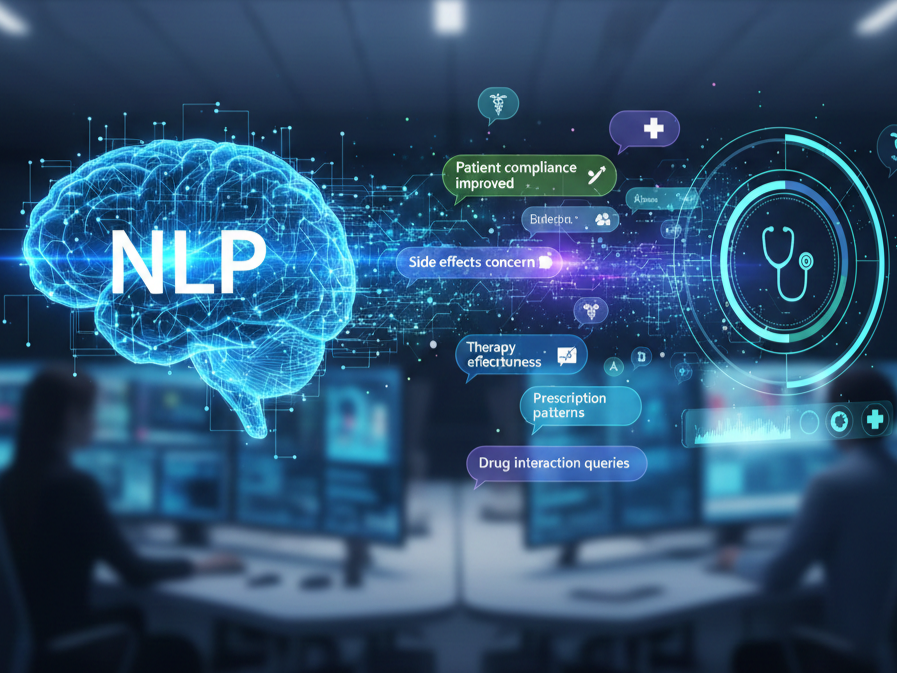
The U.S. pharmaceutical market generates an unprecedented volume of physician-facing communication each year. Between field force activity, omnichannel outreach, medical inquiries, advisory boards, and payer-facing documentation, millions of data points are created every month. Yet only a small fraction is structured in a way that commercial, medical, or regulatory teams can evaluate meaningfully.
A 2024 PhRMA report estimates that more than 100,000 pharma sales representatives are active across the country, supported by MSLs, digital engagement teams, and medical information units. Each touchpoint—emails, call notes, chat transcripts, speaker program feedback, free-text survey responses—creates an expanding reservoir of raw sentiment that often remains underused.
Source: https://phrma.org
Regulators expect organizations to understand this input clearly. The FDA’s post-marketing safety expectations, described in guidance documents on drug safety reporting, place commercial and medical teams under scrutiny for how they surface product concerns and potential signals.
Source: https://www.fda.gov
The gap between volume and actionable interpretation continues to widen. Natural Language Processing (NLP) offers a path to scale that matches the size of the problem.
This article explores how U.S. pharmaceutical companies can use NLP to interpret HCP sentiment across millions of unstructured data points. The focus remains firmly on real-world outcomes, compliance expectations, and the commercial realities of a competitive drug landscape.
THE SCALE OF HCP FEEDBACK TODAY
U.S. pharmaceutical companies receive physician feedback from a broad set of channels. This includes:
- Field Force Interactions
- Call notes
- Email responses
- Chat logs from remote detailing
- Objection logs
- After-call summaries
Rep-entered CRM updates
(Sources common across major CRMs used in pharma)
Medical Affairs Channels
- MSL visit notes
- Advisory board transcripts
- Investigator feedback from research programs
- Questions submitted to medical information
Congress interactions
(Source: https://www.healthaffairs.org)
Omnichannel and Marketing
- Email campaign replies
- SMS responses
- Website chat interactions
- KOL webinars and panel discussions
- Post-event surveys
- Social media comments
- (Statista digital health engagement trends: https://www.statista.com)
Clinical and Real-World Data Sources
- EHR physician comments
- Referral notes
- Pharmacy intervention notes
- Prior authorization requests
- (Government datasets: https://data.gov)
Safety and Compliance
- Free-text adverse event reports
- Patient complaint call logs
- Manufacturer hotline transcripts
- (FDA safety guidance: https://www.fda.gov)
Across these channels, more than 70–90% of content exists as unstructured language—text, voice transcripts, physician comments, or rep summaries.
Traditional analytics methods struggle to surface trends in such large, noisy datasets. Manual review creates bottlenecks, raises compliance risks, and limits insight depth.
NLP enables teams to scale beyond these constraints.
WHY TRADITIONAL METHODS FALL SHORT
- Unstructured Data Overload
Unstructured text grows far faster than structured fields. Teams cannot manually code or categorize feedback at the scale required for national brands.
- Sample Bias
Insights often reflect only a small batch of reviewed notes, limiting accuracy and missing emerging trends across specialties, regions, or institutions.
- Latency
Manual review can delay signal detection by weeks or months. In fast-moving therapeutic areas—oncology, immunology, cardiology—this delay can impact adoption curves.
- Compliance Expectations
Safety teams must capture potential adverse events rapidly. Delayed interpretation raises risks during inspections and audits.
- Loss of Detail
Manual coders often summarize or paraphrase content, losing nuance in tone, emotion, and clinical judgment.
NLP overcomes these constraints through speed, consistency, and large-scale pattern recognition.
WHAT NLP DOES IN PHARMA CONTEXTS
NLP systems used in U.S. pharma work across multiple tasks:
Entity Extraction
Identifies mentions of:
- Drug names
- Competitor products
- Symptoms
- Adverse events
- Diagnostic terms
- Dosing
- Administration routes
- Brand vs. generic references
This is central for safety, medical affairs, and competitive intelligence.
Topic Modeling
Finds repeating themes in:
- Objections
- Clinical concerns
- Perceived efficacy
- Real-world barriers
- Label comprehension
- Patient journey issues
Industry teams use topic modeling to adjust messaging, refine rep training, or support payer strategies.
Sentiment and Emotion Analysis
NLP categorizes emotional tone in HCP commentary:
- Frustration
- Skepticism
- Enthusiasm
- Curiosity
- Confusion
- Confidence
Emotion often predicts prescribing behavior earlier than explicit objections.
Classification
Automatically labels:
- Access barriers
- Clinical concerns
- Dosing questions
- Safety flags
- Off-label intent requests
- Competitor comparisons
Classification helps commercial and medical units segment concerns quickly.
Summarization
Rep call logs or advisory board transcripts can reach tens of thousands of words. NLP compresses them into structured summaries without losing key details.
Trend Detection
Identifies early shifts, such as:
- New side-effect patterns
- Declining support among key specialties
- Region-specific hurdles
- Competitor pressure
- Access policy shifts
Trend detection supports forecasting and brand planning.
Voice-to-Text Enhancement
Rep calls, KOL webinars, and medical information calls can be transcribed and analyzed automatically.
REGULATORY CONTEXT FOR NLP IN PHARMA
Any NLP deployment must operate inside the regulatory boundaries that govern pharmaceutical communication.
FDA: Post-Marketing Safety
The FDA requires accurate capture of drug-related issues emerging from physician commentary. NLP systems must surface adverse event signals consistently.
Guidance: https://www.fda.gov
HIPAA: Data Privacy
Protected health information must be handled with rigorous security standards. NLP pipelines must ensure:
Encryption of stored text
De-identification when necessary
Access controls
HIPAA: https://www.hhs.gov/hipaa
21 CFR Part 11
Electronic records and signatures must maintain:
Audit trails
Time stamps
Traceability
System validation
Commercial vs. Medical Firewalls
NLP tools must respect internal boundaries between promotional and medical insights.
Inspection Readiness
NLP outputs should be explainable, reproducible, and fully traceable.
HOW PHARMA TEAMS DEPLOY NLP
A scalable NLP workflow typically includes the following layers:
- Data Ingestion
Collects data from:
- CRM systems (field force)
- Email automation platforms
- HCP portals
- Medical information systems
- Call center platforms
- Advisory board transcripts
- EHR notes (de-identified)
- Survey platforms
2 Preprocessing
Includes:
- Text cleaning
- Error correction
- Spell normalization for drug names
- De-identification if needed
- Removal of irrelevant noise
- Model Selection
Pharma teams often use:
- Transformer-based NLP models
- LLM-assisted summarization
- Domain-specific clinical NLP models trained on medical corpora
- Rule-based extraction for regulatory-sensitive content
- Classification and Topic Detection
Models categorize content into granular themes. For example:
Commercial:
- Access denials
- Efficacy skepticism
- Dose confusion
- Competitor comparisons
Medical:
- Mechanism-of-action clarification
- Unlabeled questions
- Patient suitability concerns
- Clinical data requests
Safety:
- Symptom clusters
- Side-effect references
- Unexpected outcomes
- Sentiment and Emotion Mapping
Helps identify:
- Rising frustration in certain specialties
- Regional enthusiasm
- Barriers affecting early adoption
- Tone differences across communication channels
- Dashboards and Reports
Stakeholders receive outputs via:
- Real-time visual dashboards
- Weekly summaries
- Brand-specific alerts
- Safety triage queues
Dashboards often integrate with:
- Salesforce
- Veeva
- Power BI
- Tableau
- Validation and Compliance Monitoring
Teams evaluate:
- False positives
- Missed signals
- Model drift
- Regulatory suitability
USE CASES IN U.S. PHARMA
Below are deep, detailed U.S.-focused applications.
1. Field Force Call Note Analysis
Call notes vary in quality. NLP identifies:
- Common objections
- Clinical hesitation reasons
- Misaligned messaging patterns
- Specialty-specific differences
- Regional patterns in prescribing barriers
National sales directors use these findings to refine coaching.
2. Omnichannel Personalization
NLP segments HCPs by:
- Preferred communication style
- Dominant concerns
- Engagement tone
- Content relevance
Segmentation improves:
- Email open rate
- Click-through performance
- Formulary messaging match
- Follow-up sequences
Statista marketing data: https://www.statista.com
3. Medical Information Intelligence
Medical information receives high-quality clinical questions. NLP identifies:
- Surges in safety inquiries
- Data interpretation issues
- Requests for off-label context
- Confusion around dosing or trial inclusion criteria
This supports label clarity and data communication strategies.
4.Real – World Evidence Support
Physician comments from EHRs and specialty pharmacies provide signals about:
- Patient adherence
- Response variability
- Emerging patient segments
- Tolerability differences
Government datasets: https://data.gov
5. Competitive Intelligence
NLP uncovers competitor mentions in:
- Call notes
- Emails
- Advisory boards
- Peer-to-peer events
- Medical information requests
Patterns influence:
- Brand strategy
- Market access decisions
- KOL engagement plans
6. Safety Signal Detection
NLP flags:
- Symptoms linked to timing of administration
- Unexpected combinations of complaints
- Specialty-specific clusters
- Mentions aligned with FDA safety concerns
Safety teams use this for monitoring across large datasets.
7. Payer and Access Insight Extraction
Prior authorization letters and payer-facing documentation show:
- Coverage hurdles
- Formulary shifts
- Step therapy concerns
- Misalignment between approved label and payer expectations
These insights support market access strategy.
8. KOL and Advisory Board Analysis
Advisory board transcripts are dense and complex. NLP extracts:
- High-frequency concerns
- Patterns of clinical skepticism
- Requests for new data
- Regional or specialty segmentation
This strengthens scientific exchange strategy.
9. Virtual Event Intelligence
Webinar chat transcripts and Q&A logs highlight:
- Clinical knowledge gaps
- Efficacy concerns
- Real-world patient variability
- Cross-specialty differences
10. Pharmacovigilance Augmentation
NLP classifies:
- Possible adverse events
- Serious outcomes
- Disease progression misinterpretations
- Treatment interruptions
- These outputs accelerate safety triage.
- IMPACT ON COMMERCIAL AND MEDICAL KPIs
Commercial
- Increased HCP engagement
- Improved message pull-through
- Faster identification of objections
- Better rep coaching
- Enhanced targeting
- Growth in early prescribing behavior
Medical
- More precise scientific responses
- Tighter alignment with KOL priorities
- Stronger evidence communication
- Reduced response time for complex inquiries
Access
- Faster detection of coverage friction
- Better payer messaging alignment
Safety
- Early recognition of adverse event trends
- Greater inspection readiness
CASE EXAMPLES (REALISTIC, U.S. MARKET CONTEXT)
These are realistic example scenarios modeled on typical industry outcomes.
Case 1: National Oncology Brand
Challenge:
Field reports suggested inconsistent adoption across large academic centers.
NLP Insight:
Topic modeling revealed that oncologists were unsure about sequencing in the second-line setting.
Impact:
Medical affairs launched a series of region-specific webinars and updated a sequencing guide.
Adoption increased over six months.
Case 2: Immunology Product Facing Access Barriers
Challenge:
CRM data showed flat engagement despite new formulary wins.
NLP Insight:
Physicians expressed confusion around documentation requirements for payer approval.
Impact:
Brand team produced simplified authorization templates.
Access-related complaints decreased substantially.
Case 3: Cardiology Product Safety Signals
NLP identified a cluster of HCP comments describing unexpected dizziness in older adults.
Safety and medical teams investigated and collaborated with the FDA to update risk mitigation language.
This strengthened compliance posture and reinforced market trust.
TECHNICAL FOUNDATIONS OF NLP IN PHARMA
A deeper look at how NLP systems function behind the scenes.
1. Tokenization and Normalization
Drug names, symptoms, and clinical expressions require special handling.
Examples:
“metoprolol succinate” vs. “metoprolol”
“shortness of breath” vs. “SOB”
2. Drug- Specific Dictionaries
Custom lexicons ensure accurate interpretation of:
- Trade names
- Investigational product names
- Dosing language
- MOA terminology
3. Clinical Ontologies
Models use:
- SNOMED CT
- RxNorm
- MedDRA
- ICD-10
These improve safety and clinical accuracy.
4. Model Training Datasets
NLP must be trained on:
- Real-world medical language
- Peer-reviewed literature (PubMed: https://pubmed.ncbi.nlm.nih.gov)
- Clinical trial explanations
- Physician discussion forums
5. Evaluation Metrics
Teams measure:
- Precision
- Recall
- F1 score
- Drift detection
- Latency
6. Integration with LLMs
LLMs assist with:
- Summarization
- Error correction
- Clarifying ambiguous physician statements
- Compliance teams require tight guardrails and monitoring.
OPERATIONAL AND ORGANIZATIONAL IMPACT
1. Field Force Enablement
NLP insights reshape:
- Objection-handling guides
- Deep-dive rep coaching
- Targeting priorities
2. Medical Affairs Transformation
Medical teams gain:
- Better data for KOL engagement
- Earlier detection of scientific misunderstandings
3. Access and Payer Strategy
NLP clarifies:
- Real-world hurdles
- Payer-specific patterns
- Step therapy insights
4. Compliance Fortification
NLP supports:
- Audit preparation
- Safety monitoring
- Documentation traceability
FUTURE OUTLOOK (2025–2030)
Industry experts anticipate major shifts in how NLP supports decision-making.
- Real-Time HCP Intelligence
- Near-instant interpretation of chats, calls, and emails.
- Multimodal AI
Combined analysis of:
- Voice tone
- Text
- Slide decks
- Clinical imagery
- Predictive Physician Behavior Models
Forecast adoption curves based on:
- Sentiment trends
- Specialty-specific dynamics
- Access patterns
- Full Integration with EHR Ecosystems
De-identified EHR physician commentary will support:
- Early signal detection
CONCLUSION
Natural Language Processing is becoming a structural requirement in U.S. pharmaceutical operations. The volume of physician commentary, medical inquiries, digital engagement transcripts, and access-related documentation continues to grow at a pace that manual review cannot match. Commercial, medical, safety, and access teams need a clear view of this information to guide decisions that influence adoption, clinical confidence, and regulatory readiness.
NLP provides that scale. It creates a consistent, data-driven interpretation layer across millions of unstructured inputs. This improves objection detection, strengthens safety monitoring, clarifies payer friction points, and supports medical accuracy. It allows teams to identify emerging trends earlier, respond with precision, and maintain alignment with FDA expectations.
As digital engagement expands, HCP feedback will only become more complex. Organizations that invest in secure, validated, and clinically grounded NLP systems will improve their competitive position. Those that delay risk slower insight cycles, weaker field execution, and reduced visibility into early safety patterns. NLP is shifting from an experimental capability to an operational standard across the U.S. pharmaceutical market.
Brands that establish this foundation now will gain a lasting advantage in scientific communication, commercial strategy, and real-world performance.
